
Yesterday, I posted about the epidemiological crisis being reported regarding an explosion in substance use disorders resulting in increases in untreated SUDs and low rates of problem recognition. (There’s been a parallel explosion in recovery prevalence.)
All of this was predictable. In fact, we were writing about it here 13 years ago.
Despite the foreseeability of all of this, there’s been no visible effort to monitor and adjust in the context of the obvious clinical and population-level problems associated with the DSM 5’s Substance Use Disorder category.
See below:
- The first post below is from May 13, 2012, it forecasted the rise in addiction diagnoses due to the new SUD criteria and the conflation of addiction and SUD.
- The second post below is from April 8, 2012, looking at the problems with the spectrum approach and the conflation of substance misuse with addiction.
Addiction diagnoses to rise
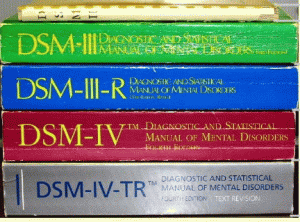
I’ve posted before about problems with the proposed approach to addiction in the DSM-5.
These changes were intended to clear up language problems, specifically the conflation of dependence and addiction, leading to “false positives” for addiction. Looks like the DSM-5 is causing its own language problems before it’s even adopted. [emphasis mine]
Many scholars believe that the new manual will increase addiction rates. A study by Australian researchers found, for example, that about 60 percent more people would be considered addicted to alcohol under the new manual’s standards. Association officials expressed doubt, however, that the expanded addiction definitions would sharply increase the number of new patients, and they said that identifying abusers sooner could prevent serious complications and expensive hospitalizations.
Further, I’m pretty skeptical of the suggestion that the current abuse diagnostic category constitutes a medical illness requiring any kind of medical treatment, and they are looking forward to the new criteria being more inclusive and being classified as having a form of addiction?
The article demonstrates the inevitable slide into viewing low-severity AOD problems as the first stage of addiction:
“We can treat them earlier,” said Dr. Charles P. O’Brien, a professor of psychiatry at the University of Pennsylvania and the head of the group of researchers devising the manual’s new addiction standards. “And we can stop them from getting to the point where they’re going to need really expensive stuff like liver transplants.”
On top of this, conflicts of interest are being exposed. It’s pretty clear that this would be a major boon for drug companies, particularly with the Affordable Care Act simultaneously increasing access to healthcare for people with AOD problems and increasing physician responsibility to treat AOD problems that they are poorly equipped to address.
Some critics of the new manual have said that it has been tainted by researchers’ ties to pharmaceutical companies.
“The ties between the D.S.M. panel members and the pharmaceutical industry are so extensive that there is the real risk of corrupting the public health mission of the manual,” said Dr. Lisa Cosgrove, a fellow at the Edmond J. Safra Center for Ethics at Harvard, who published a study in March that said two-thirds of the manual’s advisory task force members reported ties to the pharmaceutical industry or other financial conflicts of interest.
Dr. Scully, the association’s chief, said the group had required researchers involved with writing the manual to disclose more about financial conflicts of interest than was previously required.
Dr. O’Brien, who led the addiction working group, has been a consultant for several pharmaceutical companies, including Pfizer, GlaxoSmithKline and Sanofi-Aventis, all of which make drugs marketed to combat addiction.
He has also worked extensively as a paid consultant for Alkermes, a pharmaceutical company, studying a drug, Vivitrol, that combats alcohol and heroin addiction by preventing craving. He was the driving force behind adding “craving” to the new manual’s list of recognized symptoms of addiction.
“I’m quite proud to have played a role, because I know that craving plays such an important role in addiction,” Dr. O’Brien said, adding that he had never made any money from the sale of drugs that treat craving.
Dr. Howard B. Moss, associate director for clinical and translational research at the National Institute on Alcohol Abuse and Alcoholism, in Bethesda, Md., described opposition from many researchers to adding “craving” as a symptom of addiction. He added that he quit the group working on the addiction chapter partly out of frustration with what he described as a lack of scientific basis in the decision making.
“The more people diagnosed with cravings,” Dr. Moss said, “the more sales of anticraving drugs like Vivitrol or naltrexone.”
Almost Alcoholic?
This article demonstrates a big problem in understanding addiction and a big problem in the current diagnostic categories.
…when we think about alcohol abuse or alcoholism, our thoughts often go to situations like this where someone is at a stage where they are doing immediate damage to themselves or others, but what about the stage many people go through before getting to full-blown alcoholism? What about the pain and suffering, not to mention health damage, that occurs in this almost alcoholic stage? If we had more awareness of this area on the drinking spectrum, could we prevent situations like this from occurring?
It is estimated that 22 million Americans suffer from an addiction to alcohol or drugs. Helping professionals have long viewed the problem of alcoholism and addiction in absolute terms: either you are addicted, or you are not. The official psychiatric diagnostic category — alcohol dependence — is what is commonly called alcoholism. The alcoholic must drink more or less continuously to maintain a level of alcohol in his or her body. If all the alcohol is metabolized the alcoholic goes into withdrawal and experiences severe, even life-threatening physical symptoms.
What’s the issue?
Let’s start by stating that addiction/alcoholism is the chronic and relapsing form of the problem characterized by loss of control over their use of the substance.
Problems with the current DSM categories include:
- DSM dependence has often been thought of as interchangeable with addiction/alcoholism, but this is not the case.
- The current DSM dependence criteria capture people who do not have the chronic relapsing form of the problem—many of them will experience spontaneous remission.
- The current DSM dependence criteria capture people who are not experiencing loss of control of their use of the substance.
- The word dependence leads to overemphasis on physical dependence, which, in the case of a pain patient, may not indicate a problem at all.
- The word abuse is morally laden.
- For me, there are serious questions about whether abuse should be considered a disorder at all.
Same kind?
My problem with the spectrum approach is that it frames all AOD problems as one kind of problem that occurs in varying degrees. The problem here is that addiction and non-chronic dependence are different kinds of problems with vast differences in appropriate treatment approaches.
Your cousin Bob, who drank way too much in college and got into some trouble but then cut back when he started a family, has a problem that is a different kind or type from Aunt Suzie, who has multiple treatments, has had the problem for decades and it’s severely impaired her work, family relationships, friends, housing, etc.
The article illustrates my concern with this sentence [emphasis mine]:
Alcohol abuse is the diagnosis used when an individual is not yet physically dependent on alcohol but has nevertheless experienced one or more severe consequences directly attributable to drinking.
What’s the solution?
One option would be to add addiction as a third category to separate those with the chronic and relapsing form and those with loss of control from the others.
Another option might be to create two spectrums, one for forms of misuse (abuse to non-chronic dependence) and another for addiction (the chronic relapsing form with loss of control).
Keep only 2 categories, but eliminate abuse and add addiction.
I’m sure there are a lot more options. I’m concerned about the spectrum approach, but I fear the train may have already left the station. We’ll see.

 Recovery Review
This article highlights a fundamental issue in how we define, diagnose, and ultimately treat addiction and substance use challenges. The DSM-5’s broadening of diagnostic criteria has not only contributed to an epidemiological mess but has also fueled a misguided, one-size-fits-all approach to intervention.
At Family WELLth Management, we take a different stance: addiction is not a lifelong disease, and true healing happens within the context of relationships—especially family systems. The medical model’s tendency to conflate all levels of substance use into a singular pathology ignores the vast differences between problematic use, dependency, and addiction. When we lump together a college student experimenting with alcohol and a parent who has cycled through multiple treatments for decades, we lose sight of the real work needed—individualized, systemic healing that takes into account why the behavior exists rather than just what the behavior looks like.
The pharmaceutical conflicts of interest outlined here are no surprise, but they underscore a deeper issue: the over-medicalization of human suffering. Expanding addiction criteria serves institutions, not families. It turns the normal human struggle with coping into a profit-driven pathology while neglecting the environmental, relational, and emotional injuries that drive substance use in the first place.
If we truly want to see lasting change, we need to shift our focus from symptom management to sustainable family well-being. This means moving away from rigid diagnostic frameworks and toward an approach that empowers families to heal together—addressing core emotional injuries, communication breakdowns, and patterns of disconnection that fuel generational cycles of distress.
Families don’t need more diagnoses. They need guidance, structure, and a path forward that fosters resilience, connection, and long-term WELLth.
LikeLike