
“With the right kind of eyes you can almost see the high-water mark—that place where the wave finally broke and rolled back” – Hunter S. Thompson”
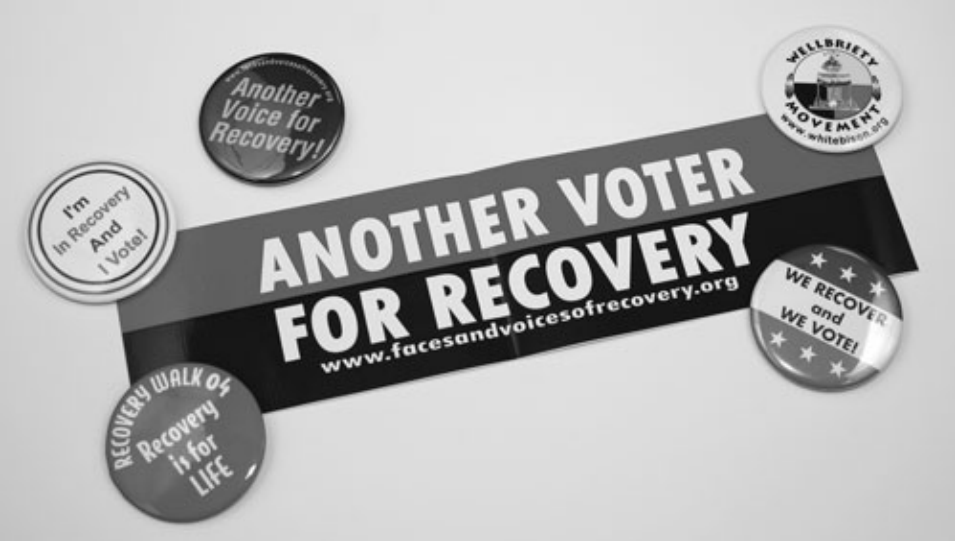
Collection of 2000s recovery advocacy ephemera. (Credit: Illinois Addiction Studies Archive)
This week I am attending the annual conference of the National Alliance on Recovery Residences (NARR). NARR is a notable success story in the recovery movement. Against the odds, the organization managed to build bonds among hundreds of recovery home operators with vastly different interests, wrangle an industry long haunted by corruption, and create a mostly united national voice for recovery housing. And yet, here at the 2025 convention, I hear speaker after speaker call for an even deeper sense of solidarity. We need a united voice, they say. They know the recovery movement has lost its ability to speak in unison. They feel the ripping forces from both directions: from above, a federal government stripping recovery resources; and from below, profiteering and a loss of focus that plagues recovery communities. If there was any time to come together, it’s now.
We’ve been united before. Bill Stauffer recently wrote about the legacy of the New Recovery Advocacy Movement (NRAM), the turning point where a long, mostly anonymous struggle matured to an open social movement for rights. Out of the early 2000s, very different voices of grassroots activism and mutual aid came together to set out a clear agenda for the future of recovery. In 2001, over 200 representatives of these organizations came together in St. Paul to change the entire face of recovery. The infrastructure that we take for granted – recovery community organizations, peer specialist positions, recovery advocacy groups – was built in the momentum of a powerful wave that started as only a trickle of scattered voices.
But nearly 25 years later, are we still together? Two years ago, Stauffer suggested the tide of NRAM was rolling back in. As early as 2013, Bill White warned that forces of corruption could lead the movement lose its focus on social change, as the quests for profit and prestige diverted us from a shared purpose of helping people find recovery. Go to any recovery event now and see these forces on full display: Organizations meant be advocacy-focused instead sell products and collect high-priced sponsorships. The term “recovery” has become ubiquitous, but also co-opted by the corrupt. And while we have more openly recovering people than ever people, people in recovery are deeply exploited. Peer specialists receive low wages in less-than-optimal working conditions, while states like Kentucky propose to bar peers with criminal backgrounds from being reimbursable.
What are these symptoms of? Are people any less concerned about recovery now than 25 years ago? No, in fact, judging by the directives of the ONDCP or priorities at NIDA, recovery is very important. These are, in fact, the side effects of popularity. In the increasing power that recovery gains, who gets to have a say in the recovery movement is shifting to those with the most money or notoriety. Today, it’s easy for a celebrity to be the face of recovery, but it’s harder to hear the concerns of local communities. More often, organizations work on their own and compete over scarce resources, losing track of their mission to help the people struggling with addiction. And, without an agenda, a sense of focus, a social movement, we are no longer able to coalesce our power into progress.
How Do We Coalesce Our Voices Again?
How did we bring together our voices before? It was useful to have organizations that represented recovery, and nothing else. During the heyday of NRAM, Bill White describes how Faces and Voices, together with a coalition of legal and recovery advocacy organizations, commanded the recovery movement at the national level, while smaller groups pushed locally. White credits the Johnson Institute, and later the Robert Wood Johnson Foundation and the Center for Substance Abuse Treatment, with funding Faces and Voices to hire staff, establish independence, and host rallying events like their annual National Recovery Rally (last hosted by them in 2023). I look to SAMHSA’s new Center for Addiction Recovery with optimism, but I also have skepticism for any organization constricted by an alignment with “federal priorities.” We need something that is represents recovery exclusively, and it’s unclear if old allies are prioritizing social change in the way they used to.
If we lack organization, we can start by creating spaces for things to naturally develop. Talking to Bill Stauffer this week, he reminded me that NRAM started with people in rooms talking, disagreeing, not being afraid of a screenshot or a recording leaking out. If you’re interested in fostering a recovery movement, I implore you to create spaces where people can speak their mind with zero fear of reprisal. Advocacy isn’t meant to be easy to talk about. You need a space to disagree, to say the wrong thing, to question each other from a place of love and trust. As I go to these conferences and attend various recovery events, I wonder what I would hear if everyone could be honest.
As a last bit of hope, I’ll leave you with a story. This year, NARR presented Oxford House with a Recovery Innovation Award. This may seem insignificant, that one recovery housing organization would give another an award. But you need some context: resources to support recovery housing have always been scarce, not all recovery houses represented in NARR align with the principles of Oxford House, and politics has sometimes favored one over the other. There is, I mean to say, some bad blood that has cropped up over the years. But here, in 2025, there’s a moment of peace, and solidarity. The representative of Oxford House walked to the podium and announced that he thought he was “punked” – the award was that shocking. As I watch, I am reminded of the first tradition of 12 step groups: personal recovery depends on unity.

 Recovery Review