
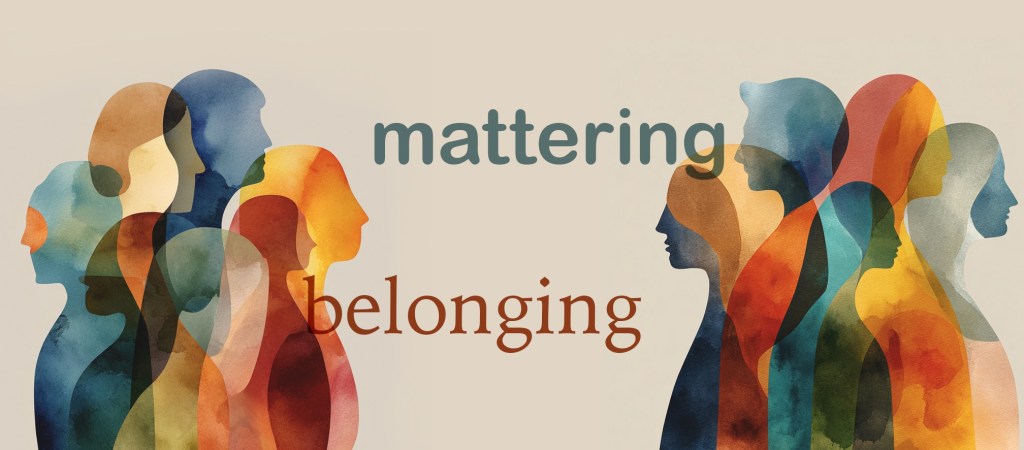
Mattering definition: being of importance; having significance in our own lives and the lives of others.
Belonging definition: a feeling of being happy or comfortable as part of a particular group and having a good relationship with the other members of the group because they welcome you and accept you.
Mattering, belonging and connection have profound implications in respect to addiction. People far too often increase their alcohol and other drug use when they feel lonely, isolated and when they lack meaningful purpose in life. We can and should address such issues within our society from a preventative perspective as well as in expanding effective remediations.
There are no simple, single causations or remedial strategies when it comes to addiction. The opposite of addiction is not just connection or for some, even related to that factor at all. Many happy, socially connected people become addicted. As a side note, for interested readers, I would highly recommend Brian Coon’s comprehensive and critical analysis of the “Rat Park” Experiment. The main takeaway here is to steer away from simple and wrong causations for addiction.
Yet it is also prudent to consider how mattering and belonging can contribute to becoming addicted for some and how being of service to others is commonly a facet of the recovery experience. One study that highlight how engaged people in recovery are is the UK 2015 Life in Recovery survey. It found that people in recovery are engaged in volunteering and civic activities at roughly twice the rate of the general public. We know that low levels of volunteering and connectivity within any community is associated with higher crime, higher unemployment, and poorer health. Conversely, If you have a lot of connected and civically engaged neighbors in addiction recovery, you benefit significantly.
We also know that social isolation, lack of mattering and loss of purpose places older adults at higher risk for developing substance use conditions. I was recently researching recovery for older adults in preparation for a presentation for the Central East ATTC, the first part of the two part training will be on July 23rd Prevention of Addiction and Substance Use Disorder in Older Adults Two Part Event and I ran across a really thought provoking study published in 2023. How older adults recovering from substance use problems experience mattering focuses on the need for people to feel like they matter in the older adult stage of life. Mattering as a factor in the prevention and recovery from substance use conditions has received scant attention until very recently. The conclusions of the 2023 study are below here in full:
“Overall, the participants’ mattering experiences rested on fair, healthy and positive community relationships and fair and attentive services, where participants could feel valued and also have a chance to add value to others. Experiences of not mattering were precipitated by lack of support, disrespect, devaluation and loss of relationships, and also by being ignored and not receiving fair treatment and help by professionals. Importantly, reciprocal and enhancing relations between mattering, recovery and relational Psychological Sense of Community (PSoC) seem to exist and to be significant for the older adults’ access to substance use services. Several practical implications are suggested to promote the therapeutic and preventive potentials of later life mattering in recovery.”
Feeling that one matters, that one belongs to the communities that they live in and a sense of purpose will gain increased importance for all of us in later life stages. There is five point scale designed for measuring mattering, the Rosenburg Mattering Scale (RMS). In 2001, further work by Taylor and Turner was done to define four foundational ways that feeling mattered is vital. They are (1) dependence (i.e., obligations arising from social bonds and the perception that one’s actions toward others will have an effect on them); (2) importance (i.e., the perception that we are of interest and concern to others); (3) attention (i.e., perceiving one’s actions as being noticed and acknowledged by important others); and (4) ego-extension (i.e., the perception that one could bring about joy or disappointment through personal successes or failures).
As we often do, when we examine substance use conditions in older adults, we have used a pathology and deficit lens instead of a strength and resilience focus. We should consider that nearly every older adult has experienced a life of overcoming challenges and mastering resiliency. This includes millions of older adults in long term recovery within all of our communities from coast to coast.
I have had the opportunity to do work within the domain of older adult addiction and recovery. In 2023, I had the distinct honor of testifying to the US Senate Special Committee on Aging on substance use conditions in older adults for the second time. In my testimony. I recommended a number of things including developing a comprehensive service infrastructure for older adults, a more robust investment in our SUD Workforce and for the inclusion of older adults in service planning strategies. Beyond those recommendations, I made one more, which was to develop an Older Adult Recovery Community Corp to better utilize the skills and talents of our older adult recovery community members. Directly from my testimony:
Create an Older Adult Recovery Community Corp to better utilize the skills and talents of our older adult recovery community members – Service to others is an inherent value of the recovery community. There are millions of older adults in recovery who could support efforts to help others heal. Older adults in recovery face the same inherent challenges of increased isolation, loss of purpose and loss in social support that is often associated with the aging process. It is likely that leveraging older adults in recovery to support the hope, purpose and connection for other older adults would be beneficial to all involved, including these volunteers.
Older adults in recovery have lived experience with mattering and not mattering. It is likely that we would discover a lot of older adults in recovery who would be willing to support others along in their recovery journeys. We may even find that these older adults in recovery have a lot of other experience, wisdom and hope to share with younger community members. Such a program would benefit older adults with substance use conditions and buffer older adult recovering volunteers against loss of mattering and purpose.
Functional societies across the history of human civilization have recognized the value that older adults have in respect to transferring knowledge and experience intergenerationally. While we have many other ways now to get information in the age of artificial intelligence, we should more greatly value authentic ways of knowing that older adults possess. We are increasingly losing connectivity to each other and the connections between our past, our present and our future. Focusing on mattering and addiction recovery in older adults may well foster connections intergenerationally while dramatically improving the lives of many of our older adult community members.
Sources
Bahl, N.K.H., Nafstad, H.E., Blakar, R.M. et al. How older adults recovering from substance use problems experience mattering. BMC Health Serv Res 23, 1453 (2023). https://doi.org/10.1186/s12913-023-10413-x
Best, D., Albertson, K., Irving, J., Lightowlers, C., Mama-Rudd, A., & Chaggar, A. (2015). The UK life in recovery survey 2015: The first national UK survey of addiction recovery experiences. https://shura.shu.ac.uk/12200/1/FINAL%20UK%20Life%20in%20Recovery%20Survey%202015%20report.pdf
Coon, B. (2024, July 13). Topic From the Field: The “Rat Park” Experiment. Recovery Review. https://recoveryreview.blog/2024/07/13/topic-from-the-field-the-rat-park-experiment/
Flett, G. L., Casale, S., Stoakes, A., Nepon, T., & Su, C. (2023). Mattering, substance use, and addictive behaviors: review, analysis, and implications for treatment and prevention. Journal of Ethnicity in Substance Abuse, 1–34. https://doi.org/10.1080/15332640.2023.2218283
Stauffer, W. (2023, December 14th). Testimony to the Senate Special Committee on Aging Understanding a Growing Crisis: SUDs Among Older Adults. William B Stauffer, Executive Director of The Pennsylvania Recovery Organizations -Alliance. https://www.aging.senate.gov/imo/media/doc/b4d0b71b-acfd-c29d-2b10-fa3449362f95/Testimony_Stauffer%2012.14.23.pdf
Rosenberg, M., & McCullough, B.C. (1981). Rosenburg Mattering Scale. https://scales.arabpsychology.com/s/general-mattering-scale/
Taylor, R., & Turner, J. (2001). A longitudinal study of the role and significance of mattering to others for depressive symptoms. Journal of Health and Social Behavior, 42, 310-325. https://www.researchgate.net/publication/11683349_A_Longitudinal_Study_of_the_Role_and_Significance_of_Mattering_to_Others_for_Depressive_Symptoms

 Recovery Review
Bill, This is by far the best writing I have ever read on SUD and older adults. I read the post from the perspective on an addictions professional and as an older adult. I paid particular attention to the importance of community and purpose. Americans are living longer. I encourage you to continue to dive deep into this area of specialization. I also hope that you and the other contributing writers of Recovery Review create a website where we can return to these posts. Thanks to all 3 writers. You make it easy for me to continue to learn without my having to get in a car and drive to a training. Mark Mark Sanders
LikeLiked by 1 person