

The peer recovery specialist owes a great deal to the therapeutic community, or TC. As much as the recovery movement has distanced itself from the blight of Synanon, Synanon and its TC offshoots were once considered the future of addiction treatment and looked to as a source of solutions by scientists and practitioners.
Seeking to distill Synanon’s magic, treatment programs in the 1960s/70s began hiring “ex-addicts”, marking the first formal roles for peers in clinical settings (more on this in Claire Clark’s excellent Recovery Revolution). Clinicians rushed to import the insider knowledge and charisma they read about in accounts of Synanon directly into their own treatment programs. The new “ex-addicts” enjoyed compliments from as high as the U.S. Department of Labor, while researchers described their magical abilities, including the “greatest potential for motivating the street addict.”
In a swirl of public fascination, David Deitch appears as a sober voice in his 1974 piece, The End of the Beginning: Dilemmas of the Paraprofessional in Current Drug Abuse Treatment (full paper here). Deitch writes from the vantage point as co-founder of the Synanon offshoot Daytop, and an academic studying the “ex-addict” movement. His explanation for the initial hype surrounding these roles feels eerily familiar,
[Treatment managers] looked to the magic that had been generated about the ex-addict, and began to both hire and use him in front lines work to create a sense of identification with the narcotic using methadone patient, and handle those tricky, potentially explosive situations in methadone clinics that they felt both inept to handle and wished to avoid. Who else then, but the ex-addict paraprofessional, who himself felt he had all the answers, whom media suggested had the answers, and was enjoying the magical status of savior.
My colleagues have described similar expectations placed on today’s peer specialists: “carrying the weight of a broken system.” In interviews they collected during COVID-19, peers described being seen as the magic answer to any difficult case, “participants believed that other mental health professionals referred clients to [peers] when it was impossible to make further progress–“washing their hands” of intractable situations…” The peer, like the “ex-addict”, still suffers from being expected to do the impossible. To fix every case and make resources appear out of thin air.
The academic also has a role to play in setting impossible expectations. Just as “lived experience” trends in today’s academic circles as the Answer, so “ex-addict experience” did in 1974,
…the professional who generally had little extensive exposure and experience in dealing with the addict, was inclined to seek out the paraprofessional and ask of him advice, tactics, his thinking, and hopefully his impressions so that they could help translate this information into treatment plans. Consequently, as new programs get funded, the ex-addict is sought out, his advice and information requested, listened to for a while and then, as the professional gains experience and competence, his attitude shifts to one of condescension when the paraprofessional attempts to make clinical input.
Are we any more receptive of what the peer specialist has to say? Probably not, as the integration of peer specialists has focused more on adapting the peer to clinical norms than the other way around. Peer specialists complain about not being included in care discussions and are frequently siloed from other professionals.
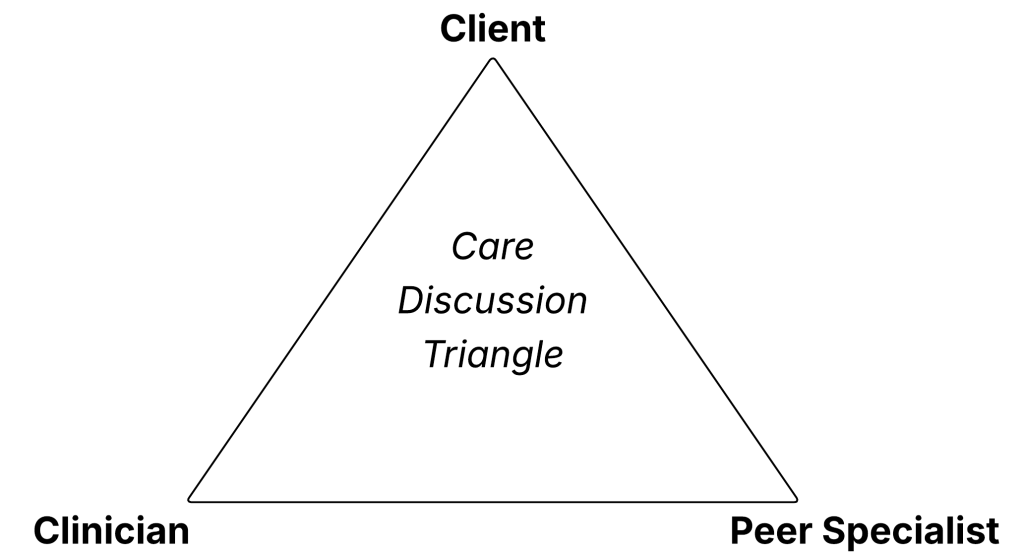
A potential solution was once shared with me by a mental health peer from Australia, who described their organization’s care discussions as a theoretical and literal triangle. When discussing a new medication, for instance, the client could turn to the clinician for a discussion of side effects, and then turn to the peer for its potential to impact their recovery (see figure below).
Deitch also shares advice for the “ex-addict” that is controversial, but worth considering,
However, if the paraprofessional wishes to remain alive in the field, mobile, competent and increasing his skills, he needs additional clinical training and with such can probably do a far better job than others less experienced.
Organizations like N.A.P.S. have set a hard precedent that peer work is decidedly non-clinical, but the number of peer workers who are trained in and enjoy motivational interviewing (MI) sets up uneasy tension. MI bills itself as a “communication method”, but also receives accusations of being an outright directive therapy, sometimes defined as such. Ultimately though, if it’s helping peers do their job, it’s hard to find the harm.
Deitch worried, in 1974, that by depriving “ex-addicts” of training, they were again set up for failure. In the case of dual diagnosis – a topic I commonly hear peers asking for more training on – he wonders, “Have we equipped him to be discerning about what might be borderline or pre-psychotic states with the potential for unpredictable regression?” or “Or have we fed into the temporary delusion that being an ex-addict makes him have the answers?”
“Ex-addicts” fell out of favor when, predictably, they failed to live up to impossible expectations. Without support and system change, they couldn’t be the saviors the professionals wanted them to be. Unfortunately, we have ignored history and repeated the same mistakes. If we only end up recreating the “ex-addict role”, peer specialists will be doomed to fail expectations again, trapped inside a system that is not designed to support long-term recovery. Until we fix these systems, peers should be afforded the opportunity to learn the skills that will help them succeed. As Deitch concluded,
…there are the vast array of other ex-addict professionals who do not think they know it all, but who currently feel that their only role in life is to occupy the front lines and who are indeed battle weary. Those who deserve and desire additional training must be provided the opportunity.

 Recovery Review
Thank you for shinning the light on this! If we don’t do anything about this dilemma, history reveals the consequences can be great. Mark Sanders
LikeLiked by 1 person
My graduate internship was in 1988-89. The term “ex-addict” was still in common use. The “ex-addict” counselors I knew at that time had graduated from TCs in the 70s. In the Minnesota Model program where I did my internship, the “regular” patients were “alcoholics” and went on the caseload of “regular” counselors, most of whom were recovering alcoholics. The “addicts” were “different” and went on the caseload of the “ex-addict”.
Even today, many counselors who are recovering alcoholics and never had a drug habit are of the opinion that a counselor who is a recovering alcoholic is a “better” counselor for the alcoholic. Especially compared to the “normie” who is considered well-intentioned but not as helpful.
A companion piece could be written: “We expect normies who call themselves ‘counselors’ to be less effective than the real counselors: a 50 year old problem revisited”. Or something like that.
Your post is an excellent one. And I think it contains some things that are very basic about human beings – things that reside underneath what we see.
Peace.
Brian
LikeLiked by 1 person
My hunch is that future research will show that when it comes to changing recovery outcomes a well-trained peer and well-trained counselor would be equal – it just comes down to the preference. Some peers are able to reach certain people who have no trust in “normie” professionals.
I think where peers excel is treatment linkage, not because of magical abilities, but because of their mapping of systems through personal experience.
However, as this post shows, we’re typically expecting peers to change outcomes, and discounting the synergy with other professionals.
LikeLiked by 1 person
I literally could not agree more.
Peace.
Brian
LikeLike
Great conversation here and on topics that have occupied a lot of my writings as well. Brian, as an aside, the overuse of the word literally figuratively drives me up the wall….
LikeLiked by 1 person