
Earlier this week, a friend shared a really interesting table from the Treatment Episode Data Set (TEDS) 2023 annual report.
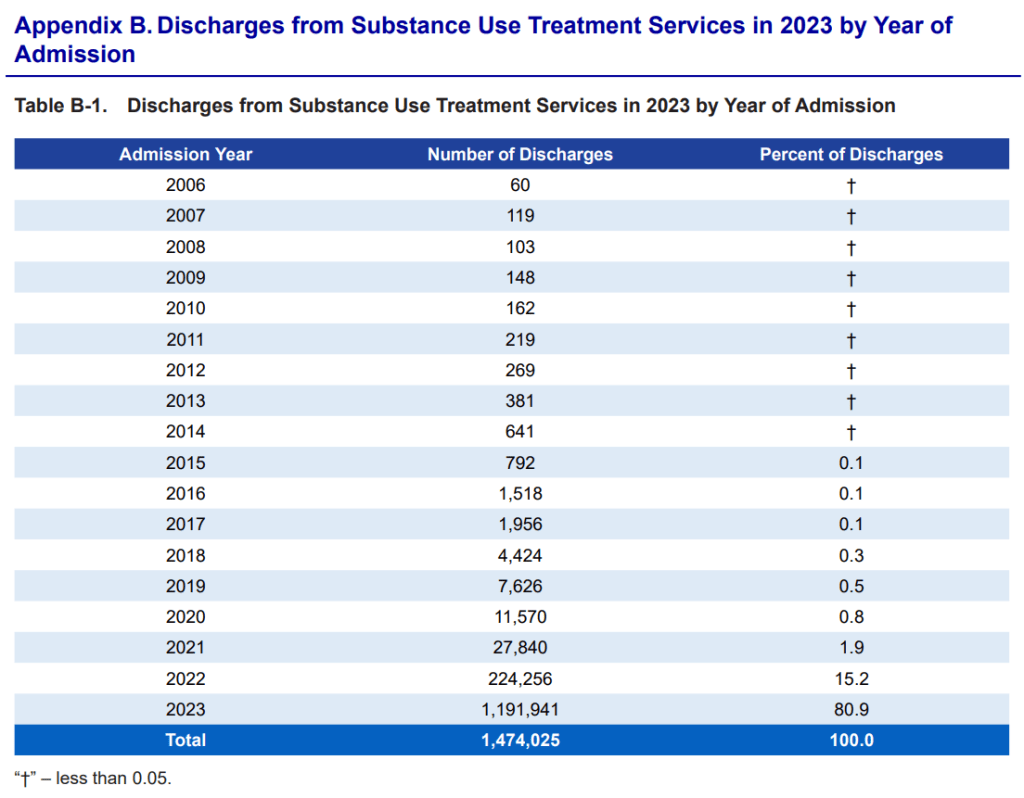
I’m familiar with the TEDS, but I don’t recall ever seeing this table of discharges by year of admission.
What this table shows is that, of the 1.4 million discharges in 2023, 60 of them were admitted in 2006 and were discharged 17 years later, in 2023.
This is really interesting. My first thought is that admissions spanning years must be methadone, and I look in the report for more information.
I was curious about the average length of admission and found this.
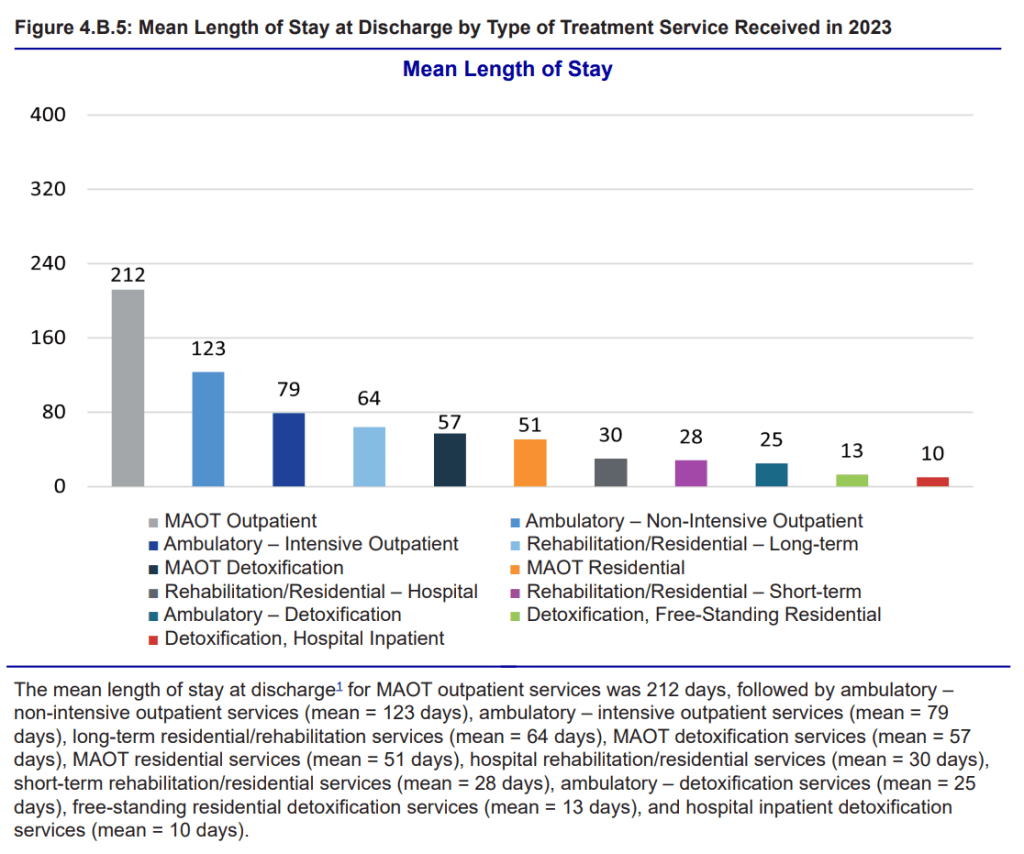
Now, it’s important to keep in mind that the length of an admission may be a lot shorter than the length of an episode. For example, a patient may be admitted to detoxification (withdrawal management) and discharged to a residential admission, then discharged to an outpatient admission. This episode would have 3 admissions and 3 discharges.
212 days for Medication-Assisted Opioid Therapy – Outpatient is pretty good, given the retention problems we often see in research. However, these numbers include people who have been in treatment for up to 17 years (6205 days).
This made me curious about the median length of stay.
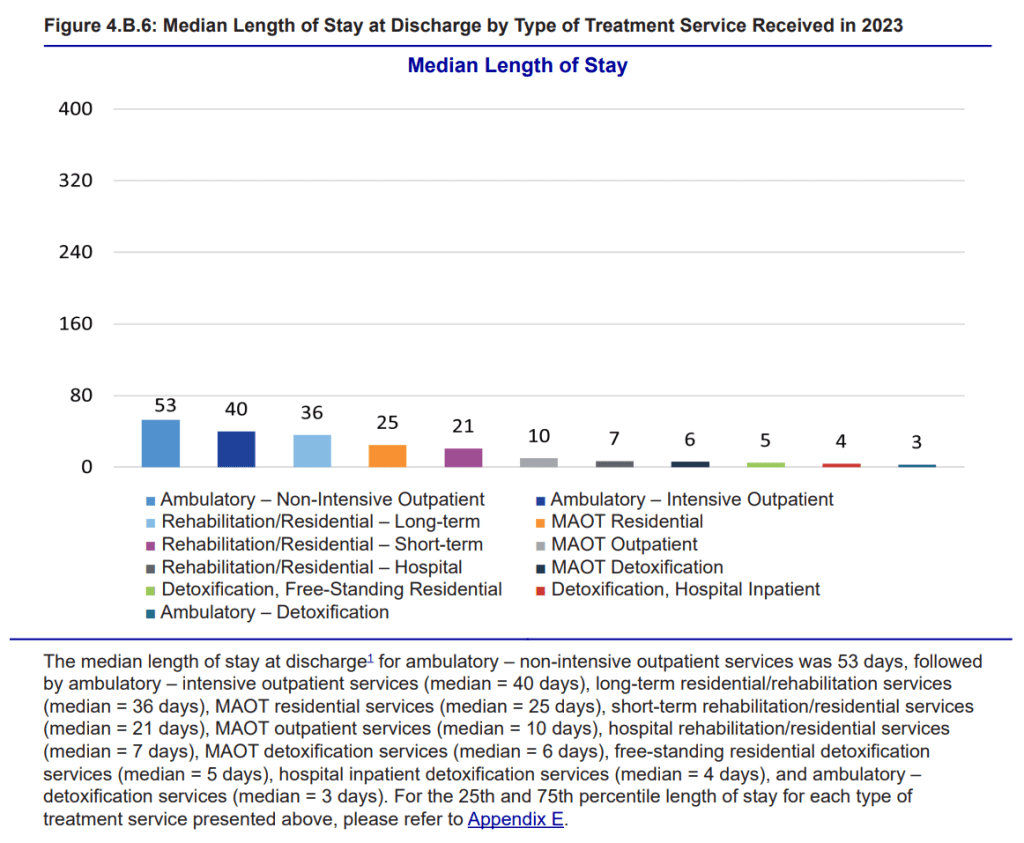
We find that the mean of 212 days for Medication-Assisted Opioid Therapy – Outpatient drops to a median of 10 days, meaning half of the admissions were retained for 10 days or less.
This reinforces the importance of the monograph on MOUD retention published last year by William L. White, MA, Marc Galanter, MD, George Kolodner, MD, Wayne Kepner, PhD, MPH, Casey Sarapas, PhD, and Candace L. Mouton, MS.
It’s very clear we have a very long way to go, given that 90 days is the benchmark for the minimum effective dose for addiction treatment (which is probably too short), and remission isn’t considered durable until 5 years of continuous recovery.
We need to know more about the patients and programs with half of patients retained for 10 days or less, and the ones retaining patients for years.

 Recovery Review