

This week produced an interesting collection of articles about drugs, their place in society, and drug policy. I thought they were worth sharing because they paint a picture of the contradictions of the moment we’re living in.
Drug Apartheid
On Tuesday, TalkingDrugs, an international drug policy advocacy news platform, published an article proposing apartheid as a framework for thinking about drug policy.
Drugs’ legality is shifting before our eyes. New Zealand tried to ban young people from legally purchasing cigarettes, while the UK prohibited the possession of nitrous oxide. Thailand may re-criminalise cannabis after struggling to control its open market, while the Netherlands is piloting the first European recreational cannabis programme. But it can be difficult to identify what motivates such changes to drug laws and how significant these are.
In this article, we offer the “drug apartheid” as a theoretical framework to contextualise how and why drug policies exist and emerge. Why, as a global society, do we have strikingly similar drug policies, where some drugs are traded freely while others are strictly prohibited? Are recent drug policy reforms challenging this model?
We define the drug apartheid as a system of inclusion and exclusion that creates an arbitrary hierarchy of substance use, privileging certain drugs, their manufacturers and consumers whilst segregating, criminalising and punishing others. This is a process tied to the emergence and establishment of capitalism with its origins lying in colonialism, empire, slavery, exploitation, as well as the advancement of global consumer capitalism.
Taylor, S. (2024, January 30). Are We in a Drugs Apartheid? – TalkingDrugs. Retrieved February 4, 2024, from TalkingDrugs website: https://www.talkingdrugs.org/are-we-in-a-drugs-apartheid/
Drug Supply Creates Drug Demand
On Wednesday, The Washington Post published an opinion piece making an argument that has fallen out of favor in recent years — that drug supply creates drug demand.
…if asked, I’d have probably agreed with the Mexican line: Demand for drugs from the United States was creating supply.
Now — after years of interviewing people with addiction, their family members, cops, traffickers and dealers, drug counselors, paramedics, ER doctors and nurses, as well as writing two books on opioids, including fentanyl — I believe the opposite: Street fentanyl, indeed all opioids, are about supply creating demand.
Quinones, S. (2024, January 31). The fentanyl crisis is being driven by supply — not demand. Retrieved February 4, 2024, from Washington Post website: https://www.washingtonpost.com/opinions/2024/01/31/fentanyl-opioid-epidemic-supply-demand/
The author makes his case with a couple of examples.
Supply creating demand is the story of our national opioid epidemic, with an inundation of pain pills creating a population of addicted consumers that didn’t before exist. Take West Virginia: In the 1990s, before it was flooded with opioid pills, it ranked near the bottom of the 50 states when it came to overdose rate. Now, it ranks first.
Or, take the word of members of the Sackler family (who have denied wrongdoing) and Purdue Pharma (which in a settlement pleaded guilty to three felonies), whose internal emails and memos make clear they knew: Supply patients with the pill OxyContin, which includes the opioid oxycodone, and they are likely to use at ever-higher doses for years. In other words, supply creates demand was virtually the Purdue business model.
Quinones, S. (2024, January 31). The fentanyl crisis is being driven by supply — not demand. Retrieved February 4, 2024, from Washington Post website: https://www.washingtonpost.com/opinions/2024/01/31/fentanyl-opioid-epidemic-supply-demand/
Of course, complex problems defy simple explanations and this may be too simplistic, but it counters assertions that minimize the role of supply. This article reminds us that there’s little reasonable doubt that supply plays an important role in demand for some substances.
Pro-drug Culture Contributes to OD Crisis
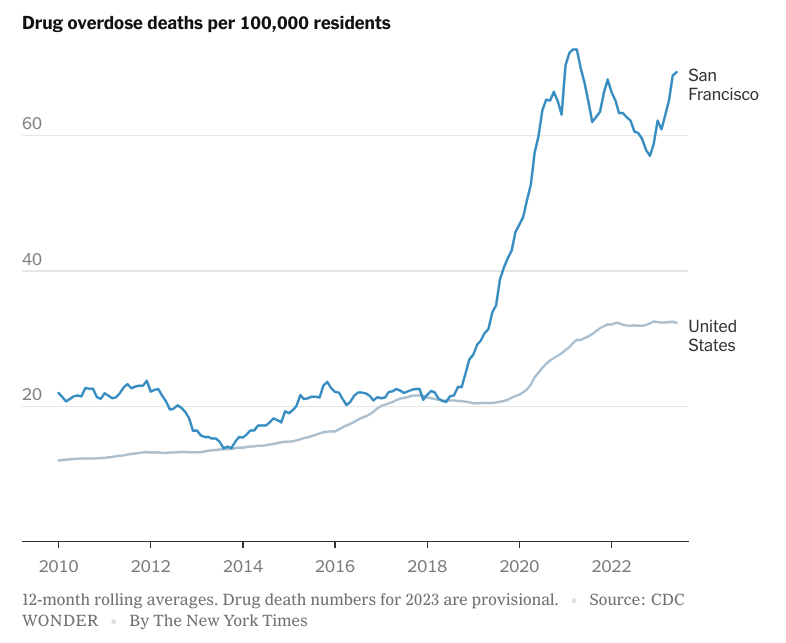
Also on Wednesday, The NYT published a story comparing and contrasting responses to drug problems in San Francisco and Portugal. They looked at decriminalization, addiction treatment, harm reduction, personal attitudes toward drugs, and comprehensive strategy.
In an accompanying morning newsletter story, the author suggests that culture is an important factor.
Culture can sound like an abstract concept, but it matters for drug policy. Consider smoking. In 1965, more than 42 percent of American adults smoked cigarettes. In 2021, less than 12 percent did. The country did not criminalize tobacco. And while policy changes like higher taxes played a role, much of the drop happened through a sustained public health campaign that led most Americans to reject smoking.
In San Francisco and other liberal cities, the opposite shift has happened with hard drug use. The culture has become more tolerant of people using drugs. When I asked people living on the streets why they are in San Francisco, the most common response was that they knew they could avoid the legal and social penalties that often follow addiction. Some came from as close as Oakland, believing that San Francisco was more permissive. As Keith Humphreys, a drug policy expert at Stanford University, told me, San Francisco “is on the extreme of a pro-drug culture.”
San Francisco’s “Pro-Drug Culture.” (2024). The New York Times.
The article identifies one important element of this “pro-drug culture” is the assertion of “bodily autonomy” — drug use as a fundamental freedom.
Academics Go Public with Drug Use to Combat Stigma
Also on that day, almost as if it was planned as a rebuttal to the NYT framing of culture as an important contributor to the relentlessness of the overdose crisis, Vice published an article about academics going public to reduce stigma.
When drug policy researcher Jean-Sébastien Fallu saw a recent op-ed in the Atlantic argue that destigmatizing drug use has been “a profound mistake,” he was furious.
The piece said “cultural disapproval of harmful behavior can be a potent force for protecting public health and safety” and that we need “more consistent rejection of drug use, not less.”
Fallu, 50, an associate professor at Université de Montréal’s school of psychoeducation, believes the opposite is true. Stigma, he said, is leading to worse health inequities and excluding people from society. It’s a feeling he’s familiar with, as an academic who for years hid the fact that he uses drugs. But now he’s “come out” about the fact that he enjoys using LSD, MDMA, 2C-B (a stimulant and hallucinogenic), weed, and alcohol, and that he thinks they’ve made him a better, more confident person. He believes his honesty, coupled with the respect he’s garnered through his career, is “destroying people’s perception that if you use drugs you’re a bad person and you cannot achieve anything good.”
“I refuse to be dehumanized,” he said.
These Academics Went Public About Using Drugs. (2024, January 31). Retrieved February 4, 2024, from Vice.com website: https://www.vice.com/en/article/y3w4nb/these-academics-went-public-about-using-drugs
The article frames discussion of drug use in academia as effective stigma reduction and an example of moral courage:
“I can look in the mirror. My children can have an example of what courage looks like in real time, not in history. It’s possible I’ll get some flak from my university, my employers. Such is life,” Hart told the Guardian about his candor.
At the conference, he issued a call to arms, encouraging other scholars to take similar stances.
These Academics Went Public About Using Drugs. (2024, January 31). Retrieved February 4, 2024, from Vice.com website: https://www.vice.com/en/article/y3w4nb/these-academics-went-public-about-using-drugs
(Drug) Enhanced Games
One way I’ve observed the cultural place of drugs change is the framing of some drugs, often stimulants and psychedelics, as lifehacks or self-optimization tools.
One manifestation of this has been the growing social media and cultural presence of supplements, steroids, and other performance-enhancing drugs as tools for enhancing health, strength, and fitness.
Also on Wednesday, news broke that billionaire Peter Theil will provide financial backing to the Enhanced Games, an olympics-like event that allows performance-enhancing drugs.
…in a recent interview with The Independent, D’Souza was defiant, and outlined how he hoped the Enhanced Games would not only shake up the world of sport, but would provide a public platform for life-extending science to thrive.
“This is the route towards eternal life,” D’Souza said. “It’s how we bring about performance-medicine technologies, that then create a feedback cycle of good technologies, selling to the world, more revenue, more R&D, to develop better and better technologies.
“And what is performance medicine about? It’s not about steroids and getting jacked muscles. It’s about being a better, stronger, faster, younger athlete for longer. And who doesn’t want to be younger for longer?”
Enhanced Games: Paypal billionaire Peter Thiel invests in controversial doped Olympics. (2024, January 31). The Independent. Retrieved from https://www.independent.co.uk/sport/olympics/enhanced-games-peter-thiel-olympics-b2488157.html
The Psychedelic Renaissance and Mystical Consciousness as a Scientific Term
On Thursday, a podcast episode was posted on “The Psychedelic Renaissance”. This episode isn’t particularly noteworthy, there are many similar articles and podcast episodes, in fact, ASAM posted a similar episode last year, but it is one more illustration of the cultural moment.
One interesting item from the show notes is, the bullet point, “why ‘mystical consciousness’ is becoming a ‘scientific term’.” This is interesting because David Nutt and other drug reform advocates started their advocacy from a place that criticized irrationality, puritanism, and superstition.
Sober Drug Use and Wellness Boosters
Finally, today, the NYT published an article on the movement to integrate ongoing drug use into the definition of “sober.”
Not long ago, sobriety was broadly understood to mean abstaining from all intoxicating substances, and the term was often associated with people who had overcome severe forms of addiction. These days, it is used more expansively, including by people who have quit drinking alcohol but consume what they deem moderate amounts of other substances, including marijuana and mushrooms.
What Does Being Sober Mean Today? For Many, Not Full Abstinence. (2024). The New York Times. Retrieved from https://www.nytimes.com/2024/02/04/us/addiction-california-sober.html
It also references the framing of some drugs as “wellness boosters”:
As some drugs come to be viewed as wellness boosters by those who use them, adherence to the full abstinence model favored by organizations like Alcoholics Anonymous is shifting. Some people call themselves “California sober,” a term popularized in a 2021 song by the pop star Demi Lovato, who later disavowed the idea, saying on social media that “sober sober is the only way to be.”
What Does Being Sober Mean Today? For Many, Not Full Abstinence. (2024). The New York Times. Retrieved from https://www.nytimes.com/2024/02/04/us/addiction-california-sober.html
It’s also worth noting that recovery and sobriety are cultural terms that have made their way into public health and treatment. The article describes two different responses from people who sought help for addiction and later decided that they could safely use drugs:
- First, the focus of the article, is on researchers, treatment providers, advocates, and patients redefining “sobriety” and “recovery” to integrate ongoing substance use. The comment from NIDA Director, Nora Volkow demonstrates this response: “‘You come to realize that there are people that are able to recover and yet they are not absolutely free of every substance,’ Dr. Volkow said.”
- The second option is to redefine the problem they sought help with, in this case as grief: “Ms. Fede said she no longer regards terms like sobriety useful and has ceased to think of herself as a recovering addict. These days, she said, her use of mushrooms and other mind-altering compounds is intentional and often done ritualistically. They have eased her grief, brought her joy and made her a better parent, she said.”
[image credit: “Contradiction-space” by victoria white2010 is licensed under CC BY 2.0.]

 Recovery Review