
I’ve completed a monograph on the conditioning theories of addictions. I plan to post the monograph next week, so everyone has an opportunity to check out this introductory overview.
The monograph addresses topics such as physical pain and pain sensitivity, emotions and emotion sensitivity, and the relationship between those kinds of experiences and drug use, as well as drug use cues.
Below is an introduction where I’ll briefly address those, the importance of this area of knowledge in addictions, and provide an overview of material for further study.
Pain, pain sensitivity, and chronic opioid use
Have you ever noticed pain sensitivity in a person with a chronic opioid use history?
An “increased sensitivity to pain or enhanced intensity of pain sensation” is the definition of the word “hyperalgesia”, according to the Merriam-Webster Dictionary.
So, let me ask if you’ve ever noticed hyperalgesia in a person with a chronic opioid use history?
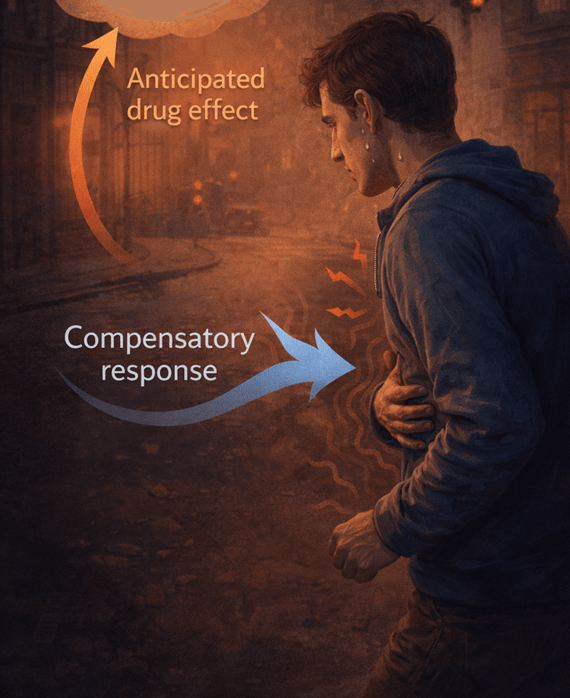
Over repeated pairings of a drug use cue, such as a syringe, and the administration of a drug, such as an opioid, the body learns to associate the cue with the impending administration of the drug.
The body learns this pairing as Pavlov figured out by accident, seeing dogs salivate when the person who feeds them enters the room.
But unlike salivation to food, the repeated pairing of a drug use cue and an opiate produces a response in the opposite direction of the drug’s effect.
Why?
The body is trying to stay neutral, or at rest, as it’s built to be. The neutral resting state is called “homeostasis”.
Thus, in the person with a long history of opioid use, one possible response to encountering an opioid use cue is feeling pain, or pain sensitivity (the opposite of opioid effects).
Have you ever known anyone who experienced that?
Another area of interest in conditioning theories of addictions is emotional feelings (rather than physical ones).
Emotional highs, emotional tolerance, and emotional withdrawal
Keeping it simple, similar questions have been asked and answered related to emotions themselves. For example:
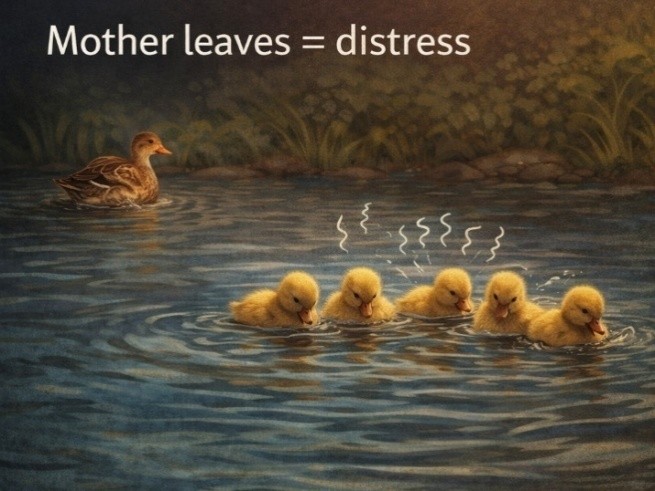
- When ducklings see their mother arrive, they are “happy”. And they show it! That’s like an emotional high.

- But after she hangs around a long time, they calm down and go back to baseline. That’s like emotional tolerance.

- And when she leaves again they don’t like that and are agitated. That’s like emotional withdrawal.
Why are conditioning theories of addictions important?
When it comes to applying conditioning theories to drug use generally, and opioid use specifically, all kinds of really interesting findings show up. And important ones too. Answers to questions like:
- What makes a cue more or less noticeable?
- What kinds of learning (bodily reactions, pursuit of pleasure, pursuit of relief) are relevant, what are the basics of how those work?
- Can tolerance, withdrawal, and other drug effects be altered by cues – not just simple use?
- What kinds of cues exist, and do some cues change the meaning of other cues?
The monograph I’ve completed provides an introductory overview of the complete topic, and draws from a number of sources. For the interest of the reader, I’ve listed various findings below in chronological order.
I hope you enjoy and benefit from the monograph when I release it next week.
Resources:
Accidental discovery that opiate use fits the Pavlovian conditioning paradigm.
- Pavlov, I. (1960). Conditioned Reflexes. NY: Dover Publications. (Original work 1927).
Pavlovian responses to opiate use are found in humans.
- Wikler, A. (1965). Conditioning Factors In Opiate Addiction and Relapse. In D. M. Wilner & G. G. Kassebaum (Ed.). Narcotics. (pp. 85-100). NY: McGraw-Hill.
Cue-elicited Pavlovian responses in humans are described as drug-compensatory.
- Siegel, S. (1979). The Role of Conditioning in Drug Tolerance and Addiction. In J. D. Keehn (Ed.), Psychopathology in Animals: Research and Clinical Practice. 143-169. NY: Academic Press.
Affective content is understood as cue-dependent.
- Solomon, (1980). The opponent-process theory of acquired motivation: The costs of pleasure and the benefits of pain. American Psychologist. 35(8): 691-712.
Efficacy of cue presentations in the extinction of withdrawal and cravings in addiction patients.
- Childress, A. R., McLellan, A. T., Ehrman, R. N. & O’Brien, C. P. (1986). Extinction of Conditioned Responses in Abstinent Cocaine or Opioid Users. Proceedings of the 48th Annual Scientific Meeting of the Committee on Problems of Drug Dependence, Inc. 76: (189-195)
Role of cognition in mediation and evocation of craving and loss of control of use.
- Corty, E., O’Brien, C.P. & Mann, S. (1988). Reactivity to alcohol stimuli in alcoholics: is there a role for temptation? Drug and Alcohol Dependence. 21(1): 29-36
Complexity of associative relationships between and among multiple cues simultaneously is explored.
- Rescorla, R. (1988). Pavlovian Conditioning: It’s not what you think it is. American Psychologist. 43: 151-160.
Determining parameters for extinction sessions in cue exposure treatment.
- Corty, E. W. & Coon, B., (1995). Extinction of Naturally Occurring Conditioned Reactions in Psychoactive Substance Abusers: Analog Studies. Addictive Behaviors. 20(5): 605-618.
Determining impact of cognitive content in the interpretation of external stimuli.
- Corty, E. W., Minehart, R. E., & Campbell, M. N. (1998). The Role of Cognitive Factors In Cue Reactivity: Extinction on Demand. Addictive Behaviors. 23(1): 123-126.
Practice guideline for methadone maintenance therapy, including a comprehensive literature review in physiology and pharmacology related to methadone, etiology and progression of opioid addiction, best practice in phases of MMT, and a medication algorithm for induction and maintenance.
- Coon, B. (1999/2006). Methadone Maintenance Therapy: A Theory and Practice Primer. Unpublished monograph.
Review article summarizing classical conditioning, its neural substrates, and events at the intra- and inter-cellular levels.
- Siegel, S, & Ramos, B.M.C. (2002). Applying Laboratory Research: Drug Anticipation and the Treatment of Drug Addiction. Experimental and Clinical Psychopharmacology. 10 (3): 162–183.
Correlations among and between affective states and activation of trauma triggers and their mediation evoking craving and escape/avoidance coping are explored.
- Proctor, S.L, Llorca, G.M., Perez, P.K. & Hoffmann, N.G. (2016). Associations Between Craving, Trauma, and the DARNU Scale: Dissatisfied, anxious, restless, nervous, and uncomfortable. Journal of Substance Use. DOI:10.1080/14659891.2016.1246621
Functional description of anxiety as an internal cue inhibiting self-care and promoting use for relief.
- White, W. L. August 27, 2020. Dying of Morbid Shyness? Social Anxiety and Addiction Recovery. William White Library Blogs, Chestnut.
Monograph reviewing the literature on tobacco smoking, vape, pouch, 6-MN, and best practices in smoking cessation during addiction treatment, leading to improved recovery rates, compared to treatment as usual.
- Coon, B, December 28, 2025. Addiction Treatment Except for Tobacco and Nicotine: A Call for Change. recoveryreview.blog

 Recovery Review
This is very interesting! Congratulations on the monograph! Mark Sanders
LikeLiked by 1 person
Thank you, sir! Hope you like it!
Peace.
Brian
LikeLike