
I did not grow up knowing what anything meant.
I don’t mean that in a poetic or existential way. I mean it literally. I spent most of my childhood in Hong Kong in the 1970s. I was in the most densely populated place on earth, surrounded by a language that had no alphabet, no phonetic bridge to my language, and no familiar cultural cues. English did not function there as a background assumption. It functioned as a private code spoken by a small minority.
I was almost five years old when I arrived. I returned to the United States just before I turned thirteen. Those years matter more than I understood at the time.
Every day, nothing was self-evident. Who spoke first. How close you stood. Whether eye contact was respectful or rude. What a smile meant. What silence meant. Even buying food involved improvisation. Prices were made up on the spot. Markets were temporary. Vendors haggled as a form of relationship, not transaction. Meaning lived in tone, gesture, posture, timing.
Language, as I later learned to call it, was already there — but it was not primary. Gesture was.
I now know that many of us in our international school were what are called third culture kids. Children whose “home country culture” does not exist in their local world. Many of my classmates had never even visited the countries printed on their passports. We were all floating, interpretive beings, learning how to read people without any stable reference point.
Understanding was never guaranteed. It had to be earned moment by moment.
That early training never left me.
When the Senses Don’t Work
Later, as a child, I spent time at a school for blind girls in Hong Kong where my mother volunteered. I would go with her. They were local Chinese girls, almost all blind from birth. The school included English, and their English was quite good.
Here’s the part that still stops me.
The only people who seemed to care that they were blind were my mother and me.
The girls themselves didn’t. They had no sense of loss. It seemed that blindness was not a deficit to them; it was simply the condition of the world. The atmosphere was calm, unselfconscious, almost peaceful. There was no drama, no tragedy, no compensation narrative.
I learned something there that therapy theories rarely acknowledge: when a sense is absent, people don’t automatically suffer — others suffer on their behalf. The meaning of impairment is not located in the body; it is located in interpretation.
Those girls taught me that “not seeing” and “not understanding” are not the same thing.
When the Mind Doesn’t Apprehend
Years later, my formal training would be in radical behaviorism and second-wave cognitive therapy — traditions that explicitly avoid “understanding” as a goal. Meaning was treated as either irrelevant or dangerous. Language was something to be corrected, not interpreted. Thoughts were categorized as rational or irrational, adaptive or maladaptive, largely from the clinician’s point of view.
What struck me, even then, was how flat this was.
Because by that point I already knew — from lived experience — that someone can hear words perfectly and still not grasp what is being communicated. And that someone can grasp what is being communicated and still defend against it. And that someone can understand you perfectly well and still not see you.
These are different failures. Therapy rarely distinguishes them.

When You Are Not Seen
For nearly twenty years, starting in my early 20s, I worked in a long-term residential addiction treatment program in the inner city. This was not outpatient therapy. This was immersion.
Crack. Heroin. Career-length sex work. Dealers. Gang affiliations. Long prison histories. Hustles refined to an art. Faked disability for public benefits. People who survived by reading others faster than they were read.
I stood out immediately.
I had two degrees when most staff had one or none. I was not formerly addicted. I was not in recovery. I looked “square”. I had never been to prison. I did not share their biography.
And yet — this is the part people expect to surprise me — it never felt exhausting. It felt like home waters.
I knew this terrain. I knew how meaning worked here. I knew that understanding was never about the literal content of what someone said. It was about tone, timing, motive, gesture, and credibility. It was about how you sounded. Whether you registered. Whether you were seen as real.
And our medical director was a psychiatrist who was blind.
That fact alone should have destabilized every simplistic theory of communication in the building.
Because the question was never whether he could see the patients. The question was whether the patients could hear him as someone who understood them.
Two Levels of Reality
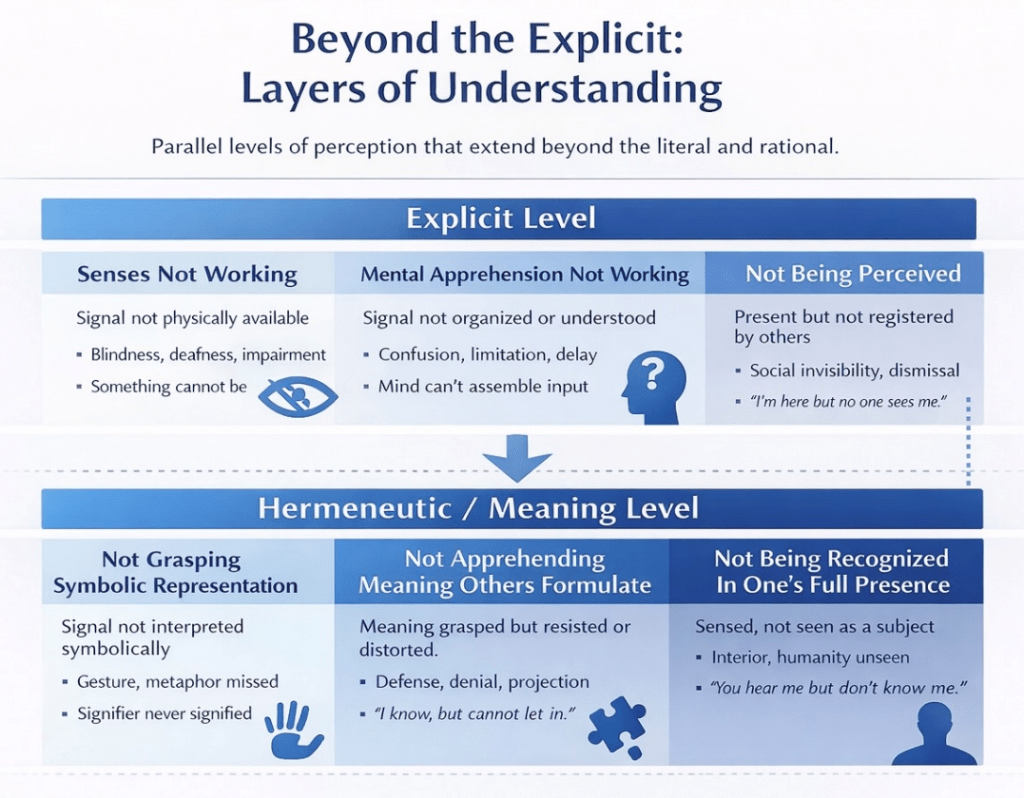
Looking back, I see life organized around two parallel realities.
On the surface level, there are obvious breakdowns:
- Senses that don’t work
- Minds that don’t apprehend
- People who are not noticed
But beneath that runs a deeper, quieter level:
- Meaning that is never grasped
- Meaning that is grasped but defended against
- Presence that is perceived but not recognized
These layers are not theoretical to me. I’ve lived in all of them.
In Hong Kong, I learned meaning without shared language.
In the blind girls’ school, I learned understanding without vision.
In “hard-core” addiction treatment, I learned recognition without shared identity.
And in all three places, I learned something that behaviorism and cognitive therapy never quite confront:
Language is not content.
Language is gesture.
Meaning is not located in words.
Meaning happens between people.
And understanding is not something the clinician does to the patient. It is something that either happens — or doesn’t — in the space between them.
Why This Still Matters
When therapies ask only whether a patient’s thoughts are rational, they quietly assume that understanding is already happening. They rarely ask how the clinician sounds. Whether the patient feels registered. Whether meaning is landing or being defended against or never forming at all.
That omission isn’t just theoretical. It’s relational.
Some people are blind and understand perfectly.
Some people see clearly and understand nothing.
Some people speak fluently and are never heard.
I learned all of that before I ever learned the word hermeneutics.
Which is probably why I’ve never been able to let go of the question.
Not: What does this mean?
But: Who understands whom — and how?
That, to me, is the real project of addiction counseling.
Suggested Reading
Reflections on “The Universal Mind of Bill Evans”
Throw flour on the invisible man: toward locating recovery function and assessing recovery quality
Addiction: understandings and enactments of the current era
Rescorla is to Pavlov as semiotics is to Freud
Comments on the task of interpreting
When evidence-based methods don’t seem to fit: an example during cognitive restructuring
Using both lenses: academic/evidence-based, and psychodynamic

 Recovery Review