
Summary
In another post in this series, I’ll highlight Bill’s paper on the concept of the “recovery carrier”. For me, if I’m asked to single out one paper above all his others that I would have someone read first – as being most critical, brief, and easy to read – that would be the one.
This paper from 2001 on the rhetoric of recovery advocacy and the power of language, by contrast, is equally important but for a very different reason. And it’s significantly longer.
I was given access to this paper not long after it first came out.
The proposals themselves were welcome and not difficult, but I found myself filled with thoughts that the reading seemed to cause.
I’ve read it and re-read it a number of times over the years. I knew it was helpful for me to read, but I didn’t know exactly all the ways that reading it was good for me. In hindsight I’ve become more clear on how it did benefit me in many ways on many levels.
Among Bill’s papers, the Recovery Carriers paper is the one that I give out most frequently. This one about the language of rhetoric is in the top 3 or so of his papers I’ve distributed or encouraged people to read.
Summarizing a paper such as this one, in a suitable way, is almost impossible for me. I’ll just say that our culture and its various sub-cultures all have different ideas, values and related language. And that this paper tackles all of that as it relates to our work. For me, this paper is a must-read.
Quotes from the paper:
Focusing on the subtle meaning of words – rejecting some while embracing others – is far more than a matter of shallow political correctness. It is about changing the way addicted and recovering people see themselves and are seen by others. It is about changing the language that affects social policies and is in turn affected by those policies. Changing language is a way to personally and culturally close one chapter in history and open another.
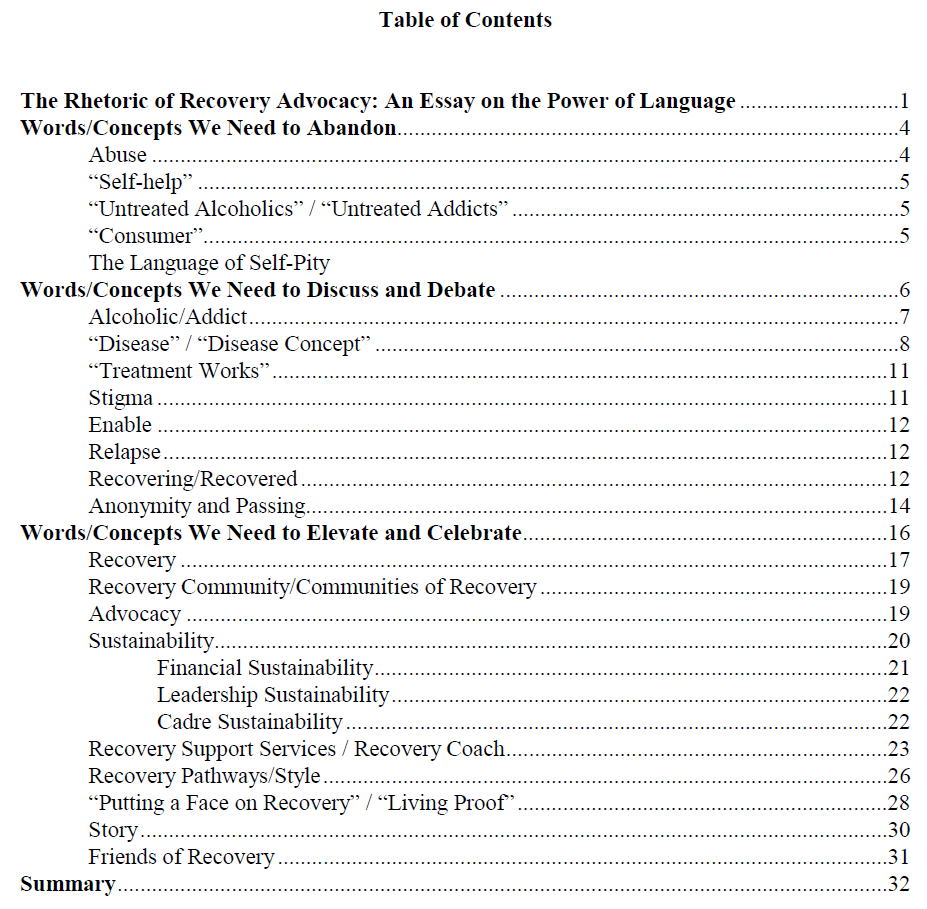
What I hope to do in this brief essay is to offer some historical and personal reflections on the words that have been the central tools in conceptualizing both alcohol and other drug-related problems and their resolution. My goal is to stimulate discussion about the layers of potential meaning that fill much of this language. For the New Recovery Movement to be “new,” it will need a fresh and dynamic language to free it from the echoes of the past. In this essay, I will call for the abandonment of some long-used words, the careful re-examination of other words, and the elevation of yet other words to the center of the New Recovery Movement.
In my post on Recovery Carriers, I’ll use a framework that includes the following sections: (1) organizational implications and recommendations, (2) relevance for today’s addiction professionals, and (3) conclusion.
I feel it would be presumptuous of me to try to discuss a paper of this kind, on a topic of this kind, in a framework of that kind. As an alternative, I’ve simply posted the paper here and strongly encourage everyone to read it.

 Recovery Review