
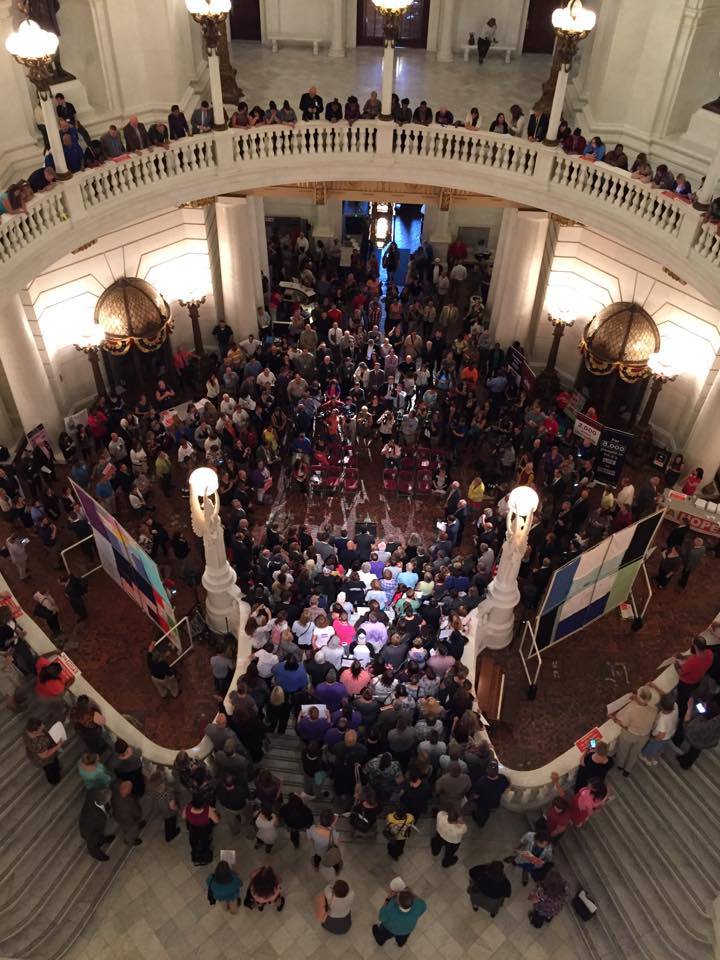
2016 Recovery Event
Pennsylvania
Authentic was a term used often and broadly a decade ago when efforts to expand recovery community organizations, elevate recovery through public facing events organized by and for recovery community, and peer support services were gaining traction in America. The term authentic was used in relation to recovery advocacy and the recovery movement to highlight an organic process that springs forth from community. Activities developed by the recovery community, for the recovery community. Conceived and facilitated by Recovery carriers of hope, who build connections in their communities, supported healing in all its forms and live with purpose to carry the message of recovery as far and wide and it needs to be heard. As historian and thought leader William White articulates, the “central strategy for building community recovery capital is through efforts that increase the density of recovery carriers (2012).” In this way, nurturing authentic processes builds recovery community beyond our formal institutions by strengthening community with a host of benefits to all within the group and broader society. Authentic recovery is the antithesis of tokenism.
It is a process grounded in advocacy, which acknowledges that while we have come a long way, we still have a very long way to go. It acknowledges the good, the bad and the ugly. The authenticity of the process can make related systems quite uncomfortable. When recovery messaging is inauthentic, it leads to profound disparity between what gets promoted and what is actually occurring on the ground. Our systems have deep flaws and blind spots. Embracing authentic recovery advocacy, including at public recovery events can only be done within inclusive and transparent processes that acknowledge our progress but also create intentional space for the uncomfortable but very real challenges we must face if we want to further expand broad recovery efforts. Efforts that must be inclusive of all of our communities through to long term recovery. Whatever else it is, recovery in its authenticity is certainly about truth telling. As uncomfortable as it may make people or related institutions, it most typically comes from a constructive place. We cannot fix what we cannot face, an important recovery lesson for millions of us.
Increasingly we must acknowledge and recognize that in the midst of authentic community-oriented recovery celebrations there are also inauthentic processes that use recovery as a prop to promote a myriad of other agendas. Processes that are not authentic and rising from community organically, but what looks more like astroturfing. Events that are top down, with predetermined agendas to promote a product or particular institutional messages not built upon the foundation of authentic community needs or goals.
It can at times look similar to what is known as Greenwashing in which industries try to package products as environmentally friendly. Recovery Marketing is what we are seeing broadly now as recovery events are occurring in deceptive ways to promote misleading, deceptive, or partially true points at the expense of the full truth by groups using recovery as a prop to market their product or policy. This is an unwelcome byproduct of the efforts of authentic and grassroots organizations around the country to elevate recovery and to show the world we do recover, and we have value to our society. What they did a generation ago worked, and now, unfortunately recovery is treated as a brand. Things are packaged as recovery oriented to have services appear more favorably or promote policy positions.
There is also a dynamic that has also been created by the infusion of money in the addiction recovery space. Money that never made it to grassroots groups or to meaningfully addresses the needs that exist within these communities. This has created a perverse reticence to acknowledge our problems as our systems want to show that the solutions, as partial or inauthentic as they are, have been effective in an emperor has no clothes dynamic. To make it appear that all is well, even when it is not so or not fully so. These dynamics are also in the interests of industry who have gotten vast sums of money for their products or treatments. Authentic recovery messages that communicate hope but also talk about what is wrong can be shut out because of the associated politics and pressures to sugarcoat partial truths or wallpaper over failed actions through Recovery Marketing strategies. This fails our whole society.
I have had the experience of seeing what a grassroots community can do when resourced to focus on their own needs in their own voices with their own talents and creativity. It started with the national celebration of recovery that occurred at the Unite to Face Addiction National Rally put together on the Washington Mall in 2015. A whole lot of people wanted to go from this local community. They organized, raised the money and went down to the historic event in the three buses that they raised the money to charter. It was an amazing event drawing people from every state in the nation. Lives were changed. People in very early recovery, thinking that the end of drug use was the end of fun learned that the opposite was true on our National Mall. Recovery in many ways is the start of life for so many of us.
They came back on the buses from the event and spoke about doing something similar in their own community. It started out as a community discussion grew. People started to contribute their energies and talents. The first year, it was relatively modestly held under a big tent with mostly local bands and speakers to a huge event, requiring yearlong planning and coordination. All those connections and collaborations pulled together diverse groups from across the community into a unified group. These connections increased the recovery capital across the entire region.
Outsiders may have only seen what was in front of the curtain, which certainly had value in elevating recovery in the community, but the true value of having the event grounded in community was the leveraging of a diverse community to support their collective goals together and collaboratively. The value of these connections has a factor many multitudes of their individual parts. Yet, from the outside it probably just looked like a big party without alcohol or other drugs. The grassroots process lost favor with the funders as they failed to see it for what it really was. It went away, and in its void, more astroturfed events set up as top-down performative processes that promoted that the government, the funders and the treatment systems wanted. Astroturfed recovery marketing productions replaced the authentic process. The energy, vitality, creativity and dedication of the community was lost. To the casual observer, the difference may be hard to discern.
Related to this is the aspirations of a Recovery Oriented System of Care (ROSC). It does not center on the government, the funders or the treatment institutions. It is about the recovery community, in all of its diversity. We are much more than props to parade in front of the media so that these institutions can feel good about themselves at our expense. This veneer of support is damaging to us and robs society of the value we offer.
Authentic recovery at its core people in the community on the journey of healing from a substance use condition working together to support each other. Of everything we have done to try and help people heal, strategies to strengthen recovery capital at the community level is the thing we have focused the least resources yet is vital for a functional ROSC. Our history shows our intuitions tend towards emphasizing top-down strategies over grassroots community solutions. Our history also shows that we lose vital momentum in our efforts when we devalue our recovery community and their capacity and drive to help others heal in this way.
As William White wrote about in Recovery Representation Revisited (2021), on Authenticity of Representation: “Do those charged with addressing our needs and aspirations represent the lived experience of recovery? Are they free of conflicts of interest? The goal here is to avoid problems of “double agentry”–individuals purported to represent the lived experience of recovery who actually represent other personal or institutional interests. This also involves the question of who selected the representative(s): were they chosen by authentic RCOs or by other institutions (e.g., alcohol or pharmaceutical industries, treatment institutions, criminal justice authorities, etc.) whose interest they will be expected to protect and promote?”
What do recovery events grounded in authentic community look like:
- Organized by and focused on the diverse insights and experiences of the recovery community.
- Focused on the journey of recovery and the myriads of ways people recovery in authentic ways.
- Transparent to the opportunities and challenges faced within our institutions of healing in authentic ways as grounded in the tradition of recovery advocacy.
What do recovery events NOT grounded in authentic community look like:
- Top-down events organized by industry or government that fail to incorporate the community in authentic ways.
- Carefully curated speakers who carry the intended, predetermined message to make things appear as they are not.
- Organized as public relations to promote products, services or policies of institutions operating in the treatment or recovery space.
Astroturfed recovery events have value, but with profound and inherent drawbacks. They can elevate recovery and show we get better, even if this truth is clouded by other messaging. People in recovery can find like-minded people at such events and understand that there are a lot of people in recovery, and we can live out loud with dignity. Yet, it can also:
- Risk loss of trust in related institutions: Unfortunately, the sad fact is the vast majority of people who have experienced a substance use condition have been taken advantage of in a myriad of ways. Preyed upon as a result of addiction and the vulnerability that comes with it. Far too often, such exploitation does not end when a person seeks help. There are many false treatments and overhyped cures. This has always been the case over the long course of history. As a result, people who use drugs or are in recovery learn as a survivor’s trait to watch what people and institutions do more than they heed what they say. When there is inauthenticity we can see, smell or sense in any way, our trust is lost. This has consequences as distrust develops and is viewed as harm under the guise of support.
- Fail to harness the untapped power of community: The only way to build recovery community capital, our most formidable healing force is to provide community opportunity to create its own strategies and solutions. Astroturfed recovery events using recovery marketing to broadcast predetermined message to promote policies of products fail to do this. They result in squandered opportunities to support what is our greatest resource, the collective talents and energy of our communities to be a contagion of hope and shared purpose.
- Demonstrated Contempt for the Value of Recovery Community: Imagine events celebrating racial and ethnic diversity that behind the curtain are tightly controlled by the dominant culture in ways that regulate the messaging and themes. Events with people from diverse communities being put in front of the process that did not authentically include them? What would that look like and feel like to the marginalized communities that have a false process of valuing in this way? That is what this kind of tokenism is experienced like within the recovery community.
If we are to create the kinds of changes that we need to strengthen recovery efforts across America beyond what we are now doing, we would need to do it in ways that differ from the past. Tokenism of recovery has been our norm and not the exception. Inclusive processes are also uncomfortable for systems steeped in the negative perceptions of addiction and persons in recovery that infuse our whole society. We are viewed implicitly as inferior and flawed. We must acknowledge this as the primary barrier to authentic inclusion. If we are to do what we need to do to move our efforts forward it will lead to uncomfortable situations for our systems and institutions. We also know that this form of un-comfortability is a sign that something must change. In recovery, we embrace this kind of un-comfortability as it tells us we are on the verge of an important change that leads to growth and improvement.
Change that needs to occur is uncomfortable but we cannot fix what we cannot authentically face. As addiction is a challenge that impacts our whole society, failure to seek authentic inclusion costs us all.
Sources
Astroturfing, New Scientist. (2007). Volume 193, Issue 2590. Page 48. ISSN 0262-4079, https://doi.org/10.1016/S0262-4079(07)60361-3
Unite to Face Addiction Rally. (2015). Facing Addiction. https://www.youtube.com/watch?v=csT3zfThKBU
United Nations. (n.d.). Greenwashing – the deceptive tactics behind environmental claims. United Nations. https://www.un.org/en/climatechange/science/climate-issues/greenwashing#
White, W. (2012). Recovery Carriers. https://www.chestnut.org/resources/69c02a74-cd69-443a-8da1-5ee9fdb78143/2012-Recovery-Carriers.pdf White, W. (2021, December 17). Recovery Representation Revisited. Chestnut Health Systems. https://www.chestnut.org/Blog/Posts/414/William-White/2021/12/Recovery-Representation-Revisited/blog-post/

 Recovery Review