
Authored by: David Best, Caroline Beidler, Mulka Nisic
Through the writings of William White, we have come to recognise that recovery is a form of social contagion spreading ripples across the surface of a tranquil pool that operates in two senses:
- It typically spreads from one person in recovery to another, through processes of social learning and social control;
- It also spreads out from the individual in recovery to their family, their neighbourhood and their community.
The combined effect of this is that we see recovery as a ‘positive sum game’ where there are dynamic and generative gains for whole community and where recovery communities are strengthened through their contributions to the wider community.
We now have a metric for this in the form of recovery capital. Although recovery capital was initially seen to adhere to individuals (whose journey to recovery was seen in part through their capacity to grow, nurture and build internal and external resources), we increasingly see recovery capital as something that can be used to describe communities and social networks as well as individuals.
Family recovery capital
While there are a series of evidence-based family recovery interventions – including CRAFT (Community Reinforcement and Family Training; Meyers et al, 2011) and the Five-Step Method (Copello et al, 2010) – support for family members of people with addictions problems remains poorly funded and inconsistently delivered in many countries. What this blog attempts to do is to highlight the work of the Global Family Recovery Alliance in translating the language of recovery capital (and the broader concept of a strengths-based approach) to addressing the needs (but also the potential) of families in recovery.
While the concept of peer-based mutual aid is evident in organisations like Al-Anon, with the underlying assumptions of empowerment and lived experience, little has been researched or written about the potential for a family recovery model predicated on social contagion and positive growth, and how recovering families may not only help each other but may act as a force for good in the communities in which they are based.
Recovery and post-traumatic growth
For our model, we are making a number of assumptions about how families recover – and it is important to note that several of the authors of this article have their own lived experience as family members and so can draw on our own experiences.
The first is that addiction in the family is a form of trauma that afflicts the whole family and so we assume that recovery needs to be a form of post-traumatic growth, defined by Slade and colleagues as “positive psychological change experienced as a result of the struggle with challenging life circumstances” (Slade et al, 2019, 1).
However, instead of the individual being the unit of analysis here, the assumption is that it is the entire family, although how the family is defined (and whether the person with the addiction continues to be seen as a part of this) may shift through the recovery process. This is seen to be a journey over time and where we cannot assume that a successful outcome will be achieved for the family.
Families and recovery capital
Granfield and Cloud (1999) developed the term recovery capital to refer to the breadth and depth of internal and external resources available to support the individual on their recovery journey. As Best and Laudet (2010) have argued this applies to internal skills and capabilities like coping skills and resilience as well as external assets like positive friendship groups and community resources (houses, college courses) that are accessible to the individual when required.
The recovery capital approach has achieved two things – one it has provided a metric that allows progress to be mapped (and then planned) but also it has switched the focus from reducing deficits to increasing assets resources and strengths, including those strengths involving group belonging and positive identities, things often eroded by the experiences of addiction within the family. For a family, those assets and resources are both the individual assets and capabilities accessible to family members but also the collective resources that can be drawn upon from being a member of the family.
So what is the Global Family Recovery Alliance?
At a time when family support groups are struggling for recognition and for funding in many parts of the world, and where the amount of research and policy focus on families of addicted individuals is limited (in spite of increased concerns about substance and process addictions), this is the launch of a global voluntary network of individuals and organisations to champion a science of family recovery based on strength-based measurement and to create an evidence base of growth and hope predicated on measurement, testing and the accrual of strengths.
To join us, you can subscribe to our mailing list by visiting www.globalfamilyrecoveryalliance.com.
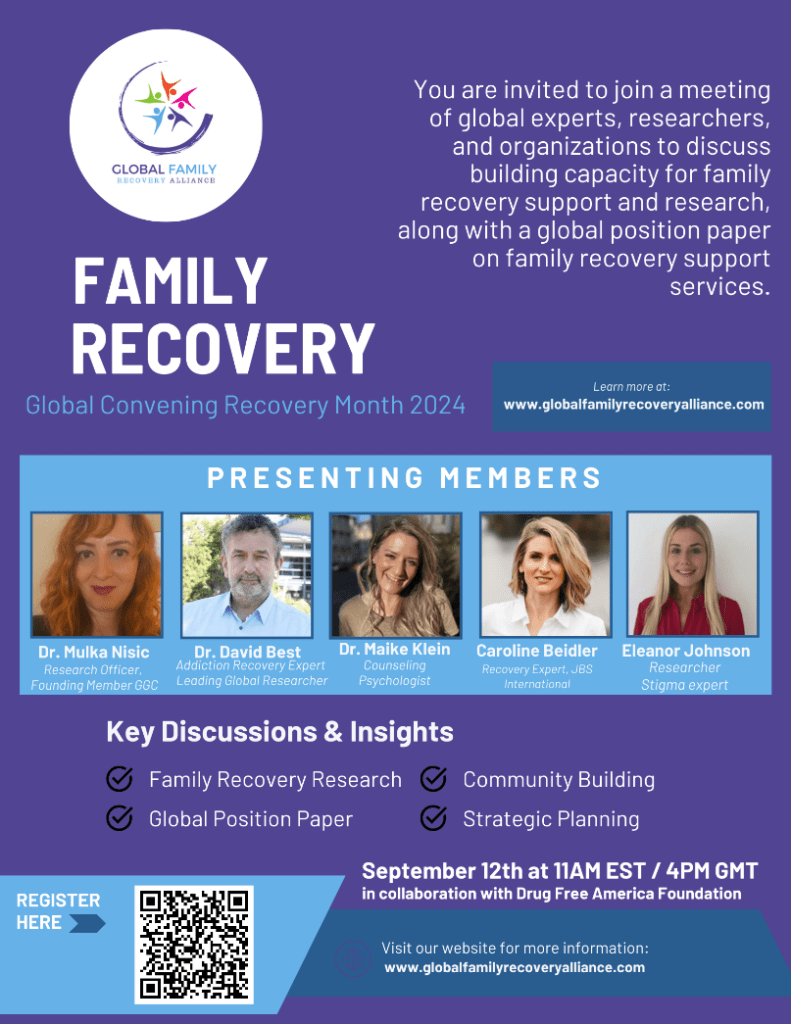
You are also invited to attend the launch event of the Global Family Recovery Alliance which is an international alliance of organizations, researchers, experts, peers, and advocacy organizations that have a common mission and vision for increased family recovery support and family recovery research around the world. At the launch event, you will have the opportunity to join the co-production of a global position paper on family recovery that aims to guide policy, practice, and research on a global scale, along with elevating the voices of affected family members.
Founding members presenting at the launch event include internationally recognized researcher and expert on Recovery Capital, Dr. David Best, Secretary General of RUN- Recovered Users Network and founding member of the Global Gender Committee within the World Federation Against Drugs, Dr. Mulka Nisic, international recovery advocate and author Caroline Beidler, MSW, and others.
Click here to register for the event.
References
Best, D. & Laudet, A. (2010) The potential of recovery capital. Royal Society for the Arts; London, England.
Copello, A., Templeton, L., Orford, J., & Velleman, R. (2010). The 5-Step Method: Evidence of gains for affected family members. Drugs: Education, Prevention and Policy, 17(sup1), 100–112.
Granfield, R. & Cloud. W. (1999) Coming clean: Overcoming addiction without treatment. New York University Press: New York.
Meyers, Robert J.; Roozen, Hendrik G.; Smith, Jane Ellen (2011). “The Community Reinforcement Approach: An Update of the Evidence”. Alcohol Research & Health. 33 (4). National Institute on Alcohol Abuse and Alcoholism: 380–8.
Slade, M., Rennick-Egglestone, S., Blackie, L., Llewellyn-Beardsley, J., Franklin, D., Hui, A., Thornicroft, G., McGranahan, R., Pollock, K., Priebe, S., Ramsay, A., Roe, D. & Deakin, E. (2019) Post-traumatic growth in mental health recovery: qualitative study of narratives. BMJ Open. 2019 Jun 28;9(6):e029342. doi: 10.1136/bmjopen-2019-029342

 Recovery Review