
The Substance Abuse and Mental Health Services Administration (SAMHSA) recently released the Recovery from Substance Use and Mental Health Problems Among Adults in the United States. It provides data from 2021 through the National Survey on Drug Use and Health (NSDUH). The press release is here. It is exciting for several reasons. Central among them is that efforts to include recovery questions into the NSDUH was the culmination of a great deal of effort by a whole lot of people over the last 20 years. We just made history!
This is first time in history that recovery questions were added to the national drug use and health survey. That we have a report of this nature is a huge step forward for the national recovery community. We can hope that this is the start of an even deeper and more methodical examination of recovery in America. Efforts in this area may well reveal that people in long term recovery are vital assets in unanticipated ways in diverse communities across the country.
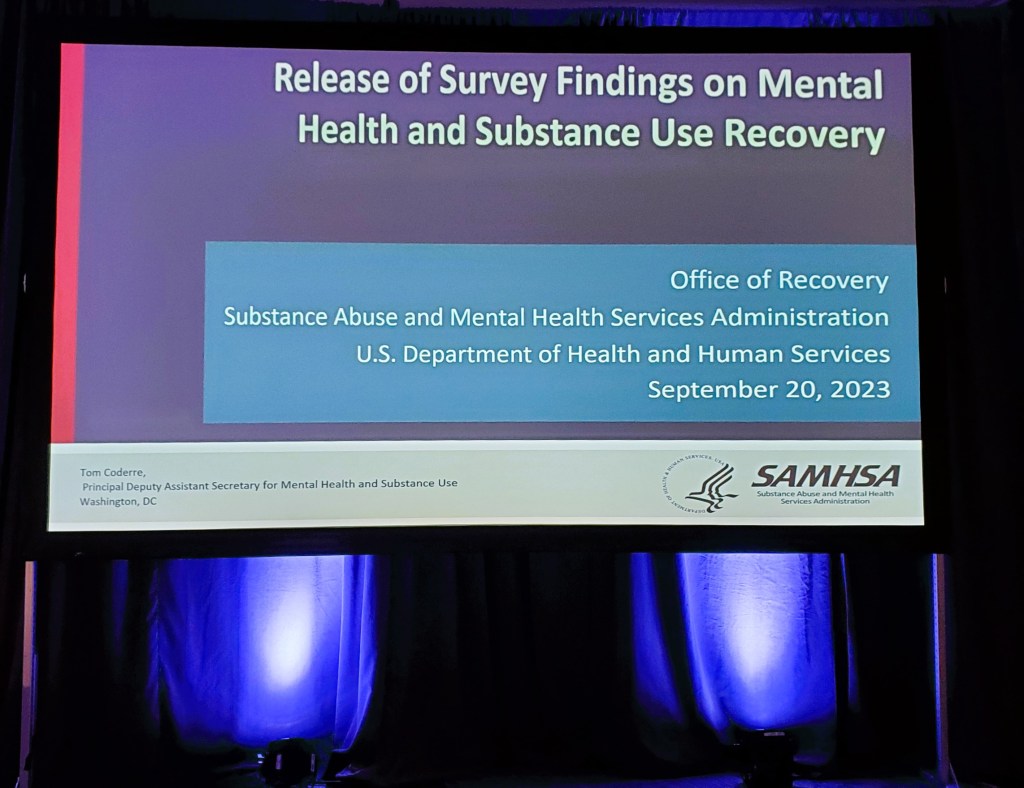
I attended the SAMHSA release of the report in Washington DC on September 20th. Tom Corderre, the first person in recovery to lead SAMHSA spoke about efforts to include recovery questions in the NSDUH. He noted that adding them to the survey tool is a vital shift from a focus on pathology to one of healing. A strength-based orientation that Bill White discusses in this video clip, captured by filmmaker Greg Williams. As the video clip notes, we still know next to nothing about long term recovery but could fill buildings with what we know about the pathology of addiction.
It was released at the end of Mobilize Recovery 2023. A fitting place and time to release it. Yet, I hope that it does not get lost as the historically significant event it was. Collecting and reporting this data is an important milestone. We should consider advocating for SAMHSA to make it an annual and expanded report, focused on furthering what we know about long-term recovery in America. Perhaps it is even possible to use such a report to bring together other work in this area, such as efforts through the Recovery Research Institute and their National Recovery Study to build out our recovery community and recovery capital knowledge base.
The report focuses on adults in recovery from their substance use and/or mental health problem and provides policy recommendations identified as supporting recovery. Bullets are findings directly from the document:
- In 2021, 70.0 million adults aged 18 or older perceived that they ever had a substance use and/or mental health problem, 72.1% (or 50.2 million) of whom considered themselves to be in recovery or to have recovered from their substance use and/or mental health problem.
- Of the 29.0 million adults who perceived that they ever had a substance use problem, 72.2% (or 20.9 million) considered themselves to be in recovery or to have recovered from their drug or alcohol use problem.
- Adults who participated in at least one government assistance program, had lower levels of education, or had a lower family income relative to the federal poverty level were generally more likely to be in substance use recovery, but less likely to be in mental health recovery.
- While not statistically significant, recovery from substance use problems was more often reported among veterans.
- In general, the prevalence of recovery tended to increase with the level of importance that adults placed on their
religious beliefs.
- The prevalence of substance use recovery was lower among adults who used alcohol, marijuana, cocaine, or a hallucinogen in the past year, while the prevalence of mental health recovery was lower among adults who used tobacco, alcohol, marijuana, cocaine, or prescription tranquilizers in the past year.
It represents a fundamental shift in understanding how we heal. This research may lead to more comprehensive, longitudinal research on recovery over the lifespan. Anecdotally, over the course of my nearly four decades of recovery, I can see the ripple effect across our community as lives change and families heal. I know mine is not an isolated experience. Understanding these dynamics and the positive impact of recovery on individual lives, families and whole communities is vital to expanding recovery efforts in America.
One of the findings in the report is that people in SUD recovery are likely to access government benefits in the recovery process. It suggests that people are not able to sufficiently support healing via private pay sources. Private insurance simply does not pay for longer term care and support. Additionally, as noted in a recent study, most people who have drug problems do not know they have coverage. Among those that do have coverage, the percentages of those who access to care is barely above the single digits. This represents a cost shift from private insurers to taxpayer funded resources. This STAT News First Opinion article “For addiction treatment, longer is better. But insurance companies usually cut it short” focuses on how this dynamic can play out. It suggests why most people who find recovery access public benefits. We would be better served by more robust care in the private sector. It is important to note that the Biden Administration has focused on enforcement of Parity Law standards, which is a good first step in this direction.
One further important note about the release of this important report. It is part of a larger effort. The lifting of recovery voices into matters impacting their own community. The development of peer service. The shift from an acute care focus to longer term, community grounded services. All examples of “community up” solutions that succeeded when policymakers listened and worked collaboratively and inclusively with grassroots communities to effect long lasting, meaningful and beneficial changes in service delivery and structure. That point should not be overlooked.
Recently, Dr Enid Osborne of CSAT authored a post on The Value of Lived Experience. There was a particular section of this piece that resonated with me and highlights the value of meaningful inclusion of recovery voices in the planning, delivery, administration, evaluation, and policy development of both services and supports at the federal, state, and local levels that I see as relevant as the origins of this report from SAMHSA originates in this very way:
Lived experience should be at the center of helping systems, but centering is more than just adding peers. Centering lived experience is an equity-focused practice that addresses implicit and structural bias in clinical systems that are built around control. Although having peer workers on staff or engaging persons with lived experience on an advisory council may be steps toward recovery-oriented systems of care, that is not sufficient for centering lived experience in policy and practice. To do so means dismantling the pathology paradigm and embracing that the social and relational dimensions of recovery that exist before, during, after the medical / clinical treatment—and often, in lieu of. There is no question that people with lived experience bring insights that can inform and improve systems, research, policies, practices, and programs. However, they must be front and center and meaningfully involved in the planning, delivery, administration, evaluation, and policy development of both services and supports to optimize results leading towards sustained long-term recovery. This applies at the federal, state, and local levels.” – Enid Osborne. PhD
At the release, audience members asked questions about expanding our inclusion. It was noted that funding the development of authentic recovery community was one of the challenges we continue to face if we are to continue to make significant forward progress. People heal in community, and then become part of community that heals other people. Few dynamics have such potential as this one.
Recovery community remains our most significant and underutilized resource in America. A resource that has proven its worth when given an opportunity to thrive. There are a number of important recommendations that this historic report identifies, one to add to that list is the meaningful inclusion of communities in recovery in ways that strengthen ground up solutions. One of the things that our history shows us is that collaborative efforts that include both “community up” and “policy makers down” approaches tend to yield more effective, longer-term results. This historic report is an example of that very dynamic. Let’s build on it, thousands of lives depend on us doing this very thing.
Sources
Mojtabai, R., Mauro, C., Wall, M. M., Barry, C. L., & Olfson, M. (2020). Private health insurance coverage of drug use disorder treatment: 2005-2018. PloS one, 15(10), e0240298. https://doi.org/10.1371/journal.pone.0240298
Osborne, E. (2023, September 19). The Value of Lived Experience –. https://recoveryreview.blog/2023/09/19/the-value-of-lived-experience/
Recovery, F. & V. of. (2013, August 17). Bill White. Vimeo. https://vimeo.com/72542240
Skerrett, P. (2023, January 13). For addiction treatment, longer is better. But insurance companies usually cut it short. STAT. https://www.statnews.com/2023/01/13/insurers-subvert-long-term-addiction-treatment-success/
Substance Abuse and Mental Health Services Administration: Recovery from Substance Use and Mental Health Problems Among Adults in the United States. Publication No. PEP23-10-00-001. Rockville, MD: Office of Recovery, Substance Abuse and Mental Health Services Administration, 2023.https://samhsa.us4.list-anage.com/track/click?u=d0780dc94825e65acd61c17dc&id=62b8324743&e=9ade7a9417 The White House Press Office. (2023, July 25). FACT SHEET: Biden-Harris Administration Takes Action to Make it Easier to Access In-Network Mental Health Care. The White House. https://www.whitehouse.gov/briefing-room/statements-releases/2023/07/25/fact-sheet-biden-harris-administration-takes-action-to-make-it-easier-to-access-in-network-mental-health-care/

 Recovery Review