
We improperly characterize what is occurring in America as an opioid epidemic, what we are experiencing is much broader than that. It is well past the time to properly account for how else the millions of Americans like me die from substance use disorders (SUDs). We fail them by not adding all the causes up and placing these losses where they would rank if we did, the number one cause of death in the United States. We need to properly frame what is occurring in order to formulate comprehensive solutions for what actually is occurring.
Such solutions most certainly would include comprehensive treatment and recovery support in the right duration and intensity for everyone having a problem. Very few people get any care, let alone the right care, in part because these deaths are not in the public narrative. When we fail to address underlying alcohol or other addictions for all persons with an OUD or other substance dependence, death is the far too often ignored reality. In fact, it is the leading cause of death in America when you tabulate it and pull it out from under all the other causes it hides in. We die in car crashes, falls, liver failure, suicides, and a myriad of other ways. It even causes bystander deaths. The first step in addressing a problem is acknowledging it is there. It is time we do. These losses matter. Let’s at least account for our losses in a visible way on a national dashboard, dignify what is happening and focus on comprehensive solutions.
Polydrug use in those diagnosed with an Opioid Use Disorder (OUD) is the rule, not the exception. Yet we only see these people one dimensionally by focusing on their OUD. Most people with OUDs have other substance use conditions, beyond which there are millions of Americans with addictions other than OUDs. We need to care enough to count. To reframe what is occurring as an addiction epidemic. Failure to do so is a blatant disregard for all persons experiencing an SUD. If we actually believe that people like me are worthy and that we can and do recover, we must do a better job at accounting for what is occurring and consider the myriad of ways we die beyond overdoses.
Alcohol still kills more of us every year than opioid overdoses. Between 2015 and 2019, excessive alcohol consumption contributed to about 140,000 deaths among adults ages 20 to 64 each year. Those deaths included acute causes like car and boating accidents, falls and alcohol poisoning, as well as chronic conditions such as liver disease or cancer. Put another way, alcohol was a factor in 1 in 8 deaths among 20- to 64-year-olds. And in people ages 20 to 49, 1 in every 5 deaths was related to excessive drinking. This is just alcohol, without considering stimulants or tobacco.
So here is a partial list of what I could find, with some reflections to put a face on these lives. Each of these stats is a person with a life story and people who loved them. We should account for the numbers and the lives, and do better:
- Hypothermia – This is a little discussed cause of death for persons misusing substances. I have known more than one person with a drinking problem who froze to death while drinking. They often passed out walking home from a bar and never woke up. This is how George McGovern lost his daughter Teresa. He wrote a book about her life and tragic death, Terry: My Daughter’s Life-and-Death Struggle with Alcoholism. According to this article, alcohol is the dominant cause of urban hypothermia. We lose hundreds of people a year to this, although from the limited information I could find in the literature, it is quite likely underreported. Senator McGovern presented at an event I attended in the early 90s. I spoke with him afterwards. The same week he lost his daughter, I lost a loved one to alcoholism. My loved one had the cause of death listed as another medical condition. This is common. We tend hide these losses because there is such stigma surrounding addiction it is often not listed as the cause of death.
- Drug Impaired Highway Fatalities – This is a common cause of death for impaired drivers and people they tragically encounter on our roads. In 2008 one of our State Senators here in PA, Jim Rhoades who was a huge advocate for helping people with addictions was hit head on by a drunk driver and died the next day in the hospital. He and his wife were driving to an official event when the tragedy occurred. The people I have lost due to drug and alcohol highway fatalities are just too numerous to count. In 2021, according to the National Highway Traffic Safety Administration, over 13,000 people died in this way. Drug Impairment accounts for around one quarter of all highway mortality. Drivers with THC in their system were roughly twice as likely to be responsible for a deadly crash and 56% of drivers involved in serious injury and fatal crashes test positive for at least one drug.
- Drownings – In the US, an average of 3,500 to 4,000 people drown per year. That is an average of 10 fatal drownings per day. According to the CDC up to 70% of deaths associated with water recreation, like boating or swimming involve alcohol, nearly 1 in 4 emergency department visits for drowning, and about 1 in 5 reported boating deaths. About half of all boating accidents involve drugs or alcohol. Waterways are second only to highways as the scene of accidental deaths in the country. When I was young, one of the first friends I had who died did so while intoxicated. He was a talented, popular kid who drowned in a river at age 19. One of the most famous people who died in this way was Whitney Houston. She drowned in a hot tub while impaired. Her story also highlights how people far too often look the other way until tragedy strikes.
- Accidental Falls – Globally, four and a half million people died from injury in 2019, and 7% are directly attributable to alcohol.Older adults, particularly male older adults who drink are at higher risk for severe injury or death.Quite recently lost a friend in this way, and the loss, like so many of these deaths deeply impacted a lot of people who loved her. It highlights that every loss is more than a statistic, but one that devastates whole communities.
- Suicides – I have lost a number of close friends who ended their lives while impaired. I suspect in a number of these instances that they would not have carried out with a suicide if they had not been impaired. It is often a significant factor. Over the last two decades, there has been a 35% increase in completed suicides in the US. While all substance use elevates the risk for suicidal behavior, alcohol and opioids are the most common substances identified in suicide decedents (22% and 20%, respectively), far above rates of marijuana (10.2%), cocaine (4.6%), and amphetamines (3.4%). In 2022, early estimates are that there were 49,449 completed suicides in the US. If we consider that 20% of suicides in the US included alcohol as a factor, this is over 9,800 people lost. A lot of people have lost a lot of friends from suicide, and substance use is often, but not always a factor.
- Losses from medical causes. Hospital admissions for drug related problems in the US have been growing in recent decades. According to this 2019 study, in United States, estimates suggested they account for 17 million emergency department visits and 8.7 million hospital admissions annually. I was not able to find stats on how many of these 8.7 million people get their substance use challenges addressed as part of their medical care, but I suspect it is quite low. They get “treated and streeted” and far too often die as a consequence. This is how most people I have met died from addiction. Those we do treat often do not get the minimum effective dose and duration of what an average person requires, which is 90 days of care. We should care enough to count the deaths and then treat people properly to stem these unacceptable losses.
- The stats below are for alcohol. They do not account for stimulants and other drugs including cannabis which are associated with a wide range of non-overdose mortality in the US:
- In 2019, there were 23,780 deaths from alcoholic cirrhosis among 224,981,167 Americans ages 25 to 85 and older, yielding a mortality rate of 10.6 per 100,000.
- An estimated 780,381 cardiovascular disease related deaths (441,893 and 338,490 CVD deaths among men and women respectively) were attributable to alcohol consumption globally in 2012, accounting for 1.4 % of all deaths and 26.6 % of all alcohol-attributable deaths. I was unable to find stats from the US.
- Seven cancers are linked to alcohol consumption: oral cavity and pharynx, larynx, esophagus, liver, colorectum, and female breast cancer. In a 2012 study, it was estimated that alcohol caused on average 19,500 cancer deaths in the US annually. Approximately 3.5 percent of all cancer deaths in the America. Cancers of the oral cavity and pharynx, larynx, and esophagus were the most common forms of alcohol-attributable cancer deaths for men, accounting for approximately 4,000-8,400 cancer deaths annually.
- Drinking and tobacco useare risk factors for stroke. Many illicit drugs have been linked to increased stroke risk (cocaine, amphetamines, opiates, phencyclidine, and marijuana). Because light drinking has been associated with reduced risk of stroke and heavy use is associated with an increased risk of stroke, data here is particularly challenging to tabulate.
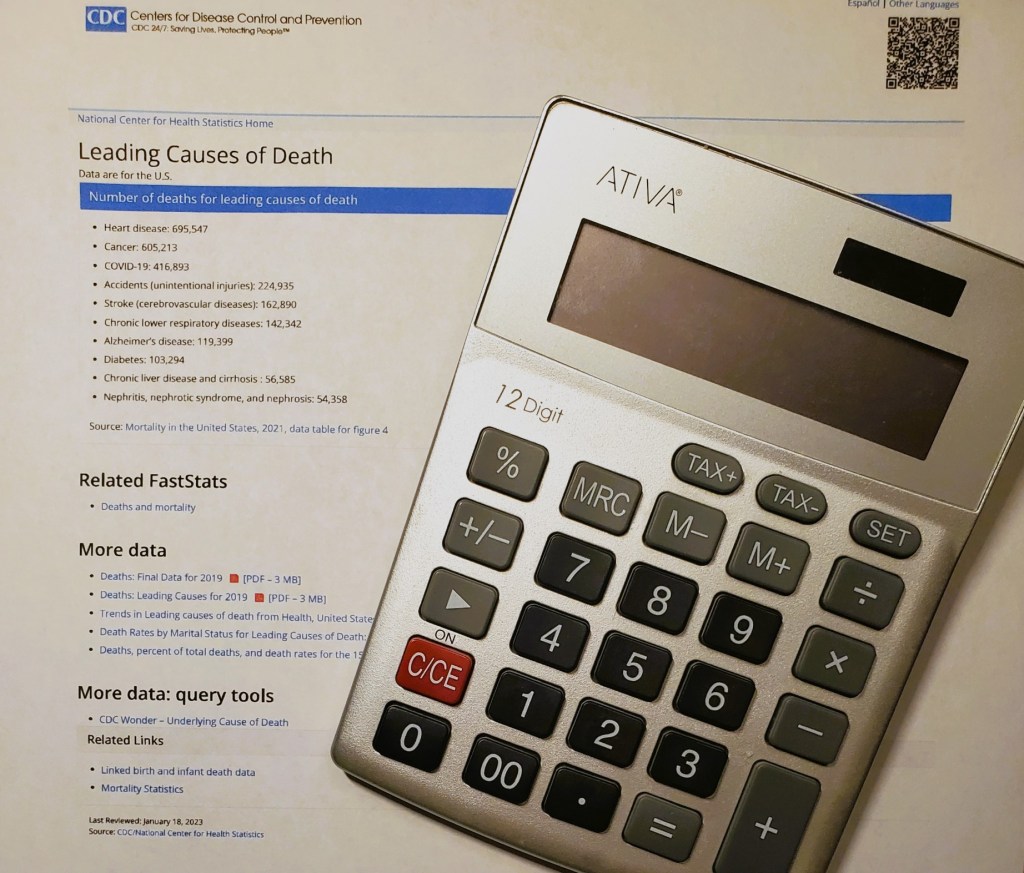
Drug associated mortality is widely under reported. This 2020 Paper estimates that drug-associated mortality in the US is roughly double that implied by drug-coded deaths alone and not only from overdoses but from a variety of causes. In 2019, the leading causes of death in America in rank order were, heart disease, cancer, COVID-19, accidents, stroke, respiratory diseases, Alzheimer’s, diabetes, chronic liver disease and cirrhosis. If we considered all the leading causes of death in the US and factored in alcohol and other drug use, it has long been noted that drug related mortality, including alcohol is the leading cause of death in America. This is how most Americans die, and we ignore it at our peril.
These stats should be upsetting to all readers. We should care enough to count what is killing our loved ones. We do not seem to care enough even to count our own dead properly. Perhaps if we did, we would address what is occurring. If we had a national dashboard of alcohol and other drug relates mortality, even if some of the stats were our best estimates, broken down by state at the very least, we would talk about and think about what is happening all around us in a more accurate way and address the most common cause of death in the United States. We could honor them and help save others simply by openly accounting for our leading cause of death in America.
Sources
Alarming Increases in Deaths from Alcoholic Cirrhosis in the U.S. (2022.). Www.fau.edu. https://www.fau.edu/newsdesk/articles/alcoholic-cirrhosis-study.php#:~:text=In%202019%2C%20there%20were%2023%2C780
Alpert, H. R., Slater, M. E., Yoon, Y.-H., Chen, C. M., Winstanley, N., & Esser, M. B. (2022). Alcohol Consumption and 15 Causes of Fatal Injuries: A Systematic Review and Meta-Analysis. American Journal of Preventive Medicine, 63(2), 286–300. https://doi.org/10.1016/j.amepre.2022.03.025
Ayalew, M. B., Tegegn, H. G., & Abdela, O. A. (2019). Drug Related Hospital Admissions; A Systematic Review of the Recent Literatures. Bulletin of emergency and trauma, 7(4), 339–346. https://doi.org/10.29252/beat-070401
Boating Under the Influence. (n.d.). BoatUS Foundation. https://www.boatus.org/study-guide/planning/bui/
Centers for Disease Control and Prevention. (2023, January 18). Leading Causes of Death. Centers for Disease Control and Prevention. https://www.cdc.gov/nchs/fastats/leading-causes-of-death.htm
Chikritzhs, T., & Livingston, M. (2021). Alcohol and the Risk of Injury. Nutrients, 13(8), 2777. https://doi.org/10.3390/nu13082777
De los Ríos, F., Kleindorfer, D. O., Khoury, J., Broderick, J. P., Moomaw, C. J., Adeoye, O., Flaherty, M. L., Khatri, P., Woo, D., Alwell, K., Eilerman, J., Ferioli, S., & Kissela, B. M. (2012). Trends in Substance Abuse Preceding Stroke Among Young Adults. Stroke, 43(12), 3179–3183. https://doi.org/10.1161/strokeaha.112.667808
Drowning Facts | Drowning Prevention | CDC. (2022, October 7). Www.cdc.gov. https://www.cdc.gov/drowning/facts/index.html#:~:text=Drinking%20Alcohol
Duke, A. (2012, April 4). Whitney Houston drowned in a foot of hot water, autopsy says. CNN. https://www.cnn.com/2012/04/04/showbiz/whitney-houston-toxicology/index.html
Glei, D. A., & Preston, S. H. (2020). Estimating the impact of drug use on US mortality, 1999-2016. PLOS ONE, 15(1), e0226732. https://doi.org/10.1371/journal.pone.0226732
Granberg P. O. (1991). Alcohol and cold. Arctic medical research, 50 Suppl 6, 43–47. https://pubmed.ncbi.nlm.nih.gov/1811578/
Hassan, A. N., & Le Foll, B. (2019). Polydrug use disorders in individuals with opioid use disorder. Drug and Alcohol Dependence, 198, 28–33. https://doi.org/10.1016/j.drugalcdep.2019.01.031
Hwang, J. S., & Kim, S. H. (2022). Severe Ground Fall Injury Associated with Alcohol Consumption in Geriatric Patients. Healthcare, 10(1111), 1111. https://doi.org/10.3390/healthcare10061111
Johnston, J. J., & McGovern, S. J. (2004). Alcohol related falls: an interesting pattern of injuries. Emergency medicine journal : EMJ, 21(2), 185–188. https://doi.org/10.1136/emj.2003.006130
Kim, S. Risk factors for severe injury following indoor and outdoor falls in geriatric patients. Arch. Gerontol. Geriatr. 2016, 62, 75–82.
Man Charged in Crash That Killed PA State Senator. (2009, January 13). WFMZ.com. https://www.wfmz.com/news/man-charged-in-crash-that-killed-pa-state-senator/article_5598623a-6635-5630-b693-ac1504a7b263.html
Leong, C., Bolton, J. M., Ekuma, O., Prior, H. J., Singal, D., Nepon, J., Konrad, G., Paillé, M., Finlayson, G., & Nickel, N. (2021). Association of alcohol use disorder on alcohol‐related cancers, diabetes, ischemic heart disease and death: a population‐based, matched cohort study. Addiction, 117(2). https://doi.org/10.1111/add.15646
National Highway Traffic Safety Administration. (2019, January 11). Drunk Driving. NHTSA; United states department of Transportation. https://www.nhtsa.gov/risky-driving/drunk-driving
Nelson, D. E., Jarman, D. W., Rehm, J., Greenfield, T. K., Rey, G., Kerr, W. C., Miller, P., Shield, K. D., Ye, Y., & Naimi, T. S. (2013). Alcohol-Attributable Cancer Deaths and Years of Potential Life Lost in the United States. American Journal of Public Health, 103(4), 641–648. https://doi.org/10.2105/ajph.2012.301199
Rizk, M. M., Herzog, S., Dugad, S., & Stanley, B. (2021). Suicide Risk and Addiction: The Impact of Alcohol and Opioid Use Disorders. Current addiction reports, 8(2), 194–207. https://doi.org/10.1007/s40429-021-00361-z
Stop Drowning Now. (2018). Facts & Stats About Drowning – Stop Drowning Now. Www.stopdrowningnow.org. https://www.stopdrowningnow.org/drowning-statistics/
US records highest number of annual suicides in 2022. (n.d.). Www.aljazeera.com. Retrieved September 16, 2023, from https://www.aljazeera.com/news/2023/8/11/us-records-highest-number-of-suicides-in-2022#:~:text=The%20United%20States%20recorded%20its
Vadim Meytes, Steven P. Schulberg, Michael Amaturo, Mohan Kilaru, An uncommon case of severe accidental hypothermia in an urban setting, Oxford Medical Case Reports, Volume 2015, Issue 12, December 2015, Pages 371–373, https://doi.org/10.1093/omcr/omv067
Weir, K. (2023, June 1).More people in the U.S. die of alcohol-related causes than from opioids and other drugs. Psychologists are working to change that. The American Psychological Association. https://www.apa.org/monitor/2023/06/tackling-risky-alcohol-use
Wilcox, H. C., Conner, K. R., & Caine, E. D. (2004). Association of alcohol and drug use disorders and completed suicide: an empirical review of cohort studies. Drug and Alcohol Dependence, 76 Suppl, S11-9. https://doi.org/10.1016/j.drugalcdep.2004.08.003

 Recovery Review
We celebrate the use of alcohol where I live. We have many micro-breweries and wineries locally and the restaurants who do the best also have liquor licenses and sell a lot of alcohol. I represent one of 21 counties in a regional entity who contracts for detoxification, treatment and prevention services. Our largest presenting problem for treatment is alcohol followed by opioids and then stimulants.
LikeLiked by 1 person
Thank you for your comment, Terrance. As increased access to alcohol has been normalized across our society, we have also normalized these deaths in ways that make them harder to address. This itself should be a matter of focus if we are to help more people heal from alcoholism.
LikeLiked by 1 person